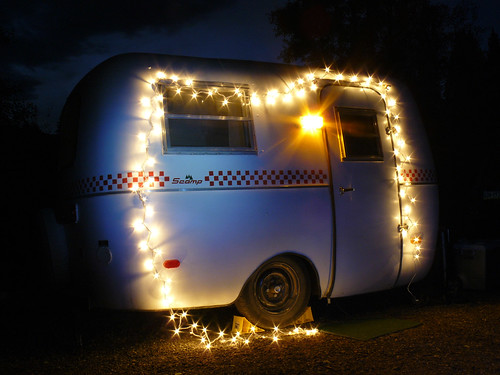
How cute can you get??
July 30th, 2009Finally caught one…now what??
July 28th, 2009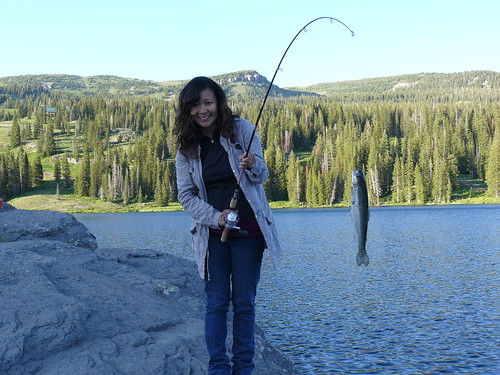
This looks like it’s going to be a victorious tale about man vs. fish. But it’s not…
Mike and I had been attempting to catch fish for the last 6 weeks without success. We were so desperate that when a 6 year old boy told us about salmon roe and powerbait, we ran out to the store the next day and bought some. For those who don’t know, salmon roe is obviously fish eggs that are baited to a hook. Powerbait is glitter covered playdoh in neon colors with a fishy scent. Trout have keen eyesight, and know to avoid a hook if they see one (according to Wikipedia or some other internet source we read from). By molding the powerbait over the hook, the trout swallows the glow-in-the-dark bait whole.
Well, let me tell you…powerbait works. After only a few minutes Mike almost had his first catch ever! He caught a fish, but just as he almost had it reeled in, the line broke. So, technically he hasn’t caught anything. I threw my reel in and fairly quickly caught this fish pictured above. This is where the tragedy comes in…
Once we got the fish out of the water, we weren’t sure what to do. We weren’t going to keep it, it looked too small. Because the fish was flapping around, Mike couldn’t get a grip on it, and now Mike’s hands are flapping around, and were both looking panicked about what to do next. And he says accusingly, “I thought you knew what to do once you catch a fish. You’ve been doing this all your life.” My thought was, “Dad, can you unhook my fish?” I’ve never unhooked a fish in my life, that’s what dads do for their little girls growing up. So, even with with Mike flapping his hands and all jittery, we finally get the fish on the ground, but can’t see the hook. The rainbow trout swallowed the hook so far that it’s in the back of its throat. I can’t seem to get my fingers down by the hook, the fish is now starting to bleed, and so we decide to cut the line, and toss the little guy back in the water. But it floats to the top. OH, NO. It’s dead. And now on this beautiful lake, there is a dead fish floating on the water.
So we decide to try to hide the evidence of our killing. Using the end of our fishing pole, we try to bring it back to shore. But some how the fish gets submerged, and stays underwater. We wait for it to float back up, but it doesn’t. After a while, we resume fishing, but are afraid. We are afraid our dead fish might reappear, and we are afraid we might catch and kill another fish. After 20 minutes the stress becomes too unbearable, and we head back to our camper– we might have had vegetarian curry that night.
Beautiful Colorado
July 28th, 2009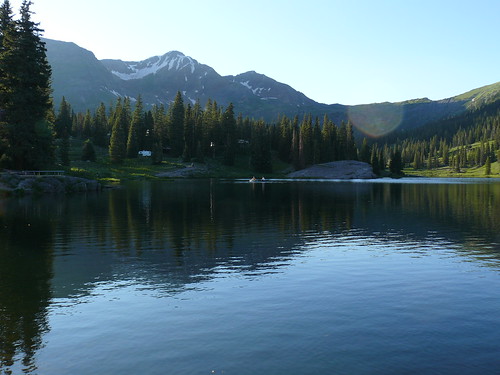
From Leadville, we drove on smaller roads through a few mountain passes to get to the Crested Butte region. It was a beautiful drive, green pine and aspen filled mountains littered with wildflowers. It’s green everywhere except at the peaks where the mountains snow has yet to melt, like at the top of the Cottonwood Pass. Eventually, the peaks, pines and flowers give way to a peaceful, serene Lake Irwin. It kind of feels like you discovered something or stumbled on a little treasure. I should keep this little place to myself, but it’s too good not to share. There is a campground here, with about 20 campsites (a few are right on the water). This by far was my favorite place to stay this whole trip.
Molly Brown Campground, perfect with family
July 28th, 2009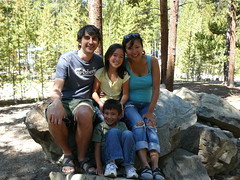 We met my brother and his family in Leadville, Colorado (about an hour south of Vail, Co.) for a few more days of camping. Molly Brown Campground is a nice, shaded campground with plenty of tall pines, and lots of privacy. Although our campsite wasn’t right on Turquoise Lake, there were plenty of spots that were.
While there we went canoeing on Twin Lakes, tried our hand (unsuccessfully) at fishing, grilled on the open fire, and ate roasted smores. Two days of camping is the max. limit of days for my brother, at which time we split up. They headed north towards Denver, and Mike and I headed west in search of a shower. I guess you could say our one limitation without a shower in our Scamp, is that every few days we have to figure out how we are going to get clean.
Bandelier National Monument
July 27th, 2009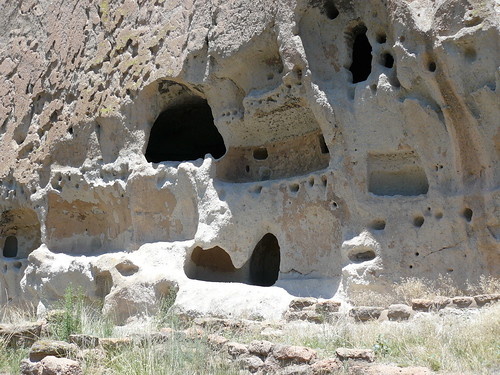
It’s hard to tell in this photo, but essentially this is a cliff dwelling, where the Ancestral Pueblo people lived. They carved into the porous volcanic rocks to construct rooms used for sleeping, cooking, and storing food. The Ancestral Pueblo people hunted the land for game, such as bison, deer, rabbit, but mainly they were farmers, relying on rains for successful crops. As the region fell into a drought, these dwellings were abandoned for better water resources along the Rio Grande sometime around 1550AD.
Collared lizard keeping a look-out
July 21st, 2009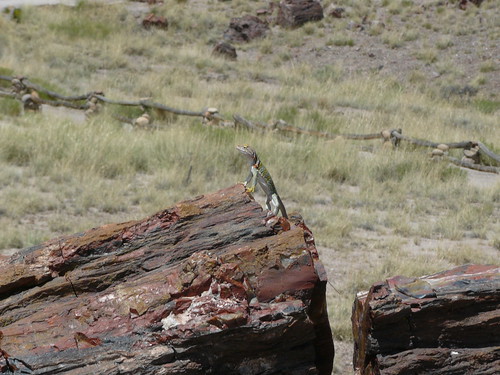
Sedona, AZ
July 21st, 2009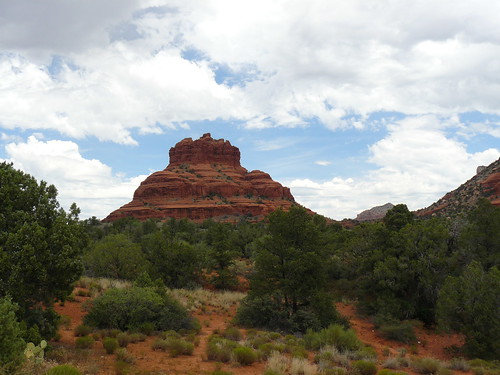
The red rock formations of Sedona are stunning to behold, but there is much more depth to the rocks than meets the eye. There are special spiritual vortexes that exist in Sedona. These energy centers are located around Sedona, and can be more intense at the actual site of each vortex (4 main vortexes in Sedona) where a person may feel uplifted, inspired, or a strong positive sensation.
The above is Bell Rock, where the “balance” of masculine and feminine vortex is located. I’m not sure if it was the vortexes I felt, but in a place so beautiful, how can you not feel good??
Zion, the Big Rig and the Scamp
July 6th, 2009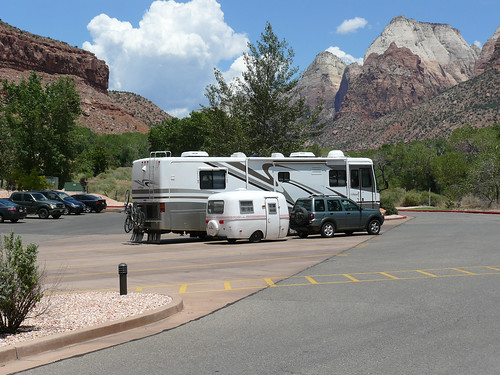
North Rim of the Grand Canyon
July 5th, 2009 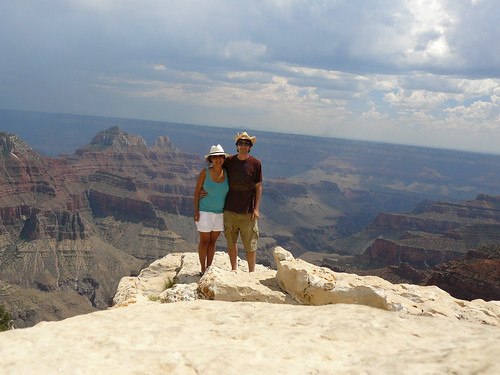
In the early summer of 1993 after graduating from university, my mom and I drove my little Honda Accord out to Los Angeles to start my first job. Our drive out to LA was an adventure. Remember when there were no safety nets like cell phones or the internet. Driving across the country, you were on your own. If you ran out of gas, you were walking to a gas station. If your tire needed to be changed, you hoped a pay phone was nearby to call AAA. Cross-country travel was still considered dauting and exciting.
Aside from sleeping at night, my mom and I drove straight from Michigan to California with the exception of making one stop– at the Grand Canyon. The allure of the Grand Canyon took us off the highway, turning us into tourists, if not for just one hour. That was the first and only time my mom and I ever did anything so adventurous, just the two of us. It was a fun trip. Thanks mom.
When I get home to Philadelphia, I’m going to see if I can find the photo that was taken in 1993 with my mom and I (rather than Mike and I, as above) standing in the exact same place in front of the North Rim of the Grand Canyon.
Horseshoe Bend overlook
July 4th, 2009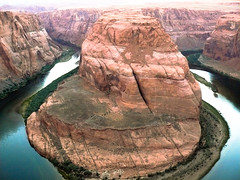
Antelope Canyon
July 2nd, 2009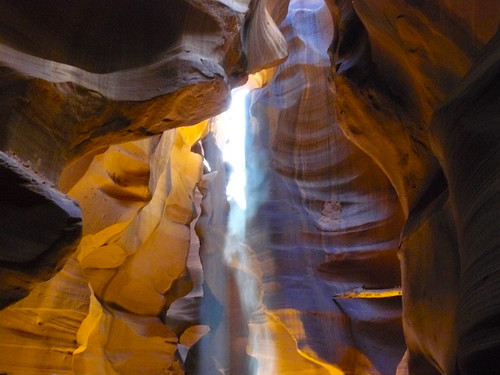
The Chains at Glen Canyon
July 2nd, 2009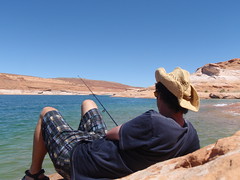 From Arches NP we headed down to Glen Canyon to visit beautiful Lake Powell. We based ourselves at Lake Powell’s Waheap campground, and checked out several different sites around Page (the main town).
There is a turn-off right next to the dam, where you can park and walk down vermillion sandsone rocks to a small fishing/swimming spot called The Chains. We were told frozen anchovies were good bait for catching bass or rainbow trout. The water is so clear we could see the fish swimming just below us. These fish were probably 14″ or more. But they wouldn’t bite. Finally I caught a fish, but it was only a 5″ rainbow trout that we sent back into the water. After 4 hours fishing, all we got were strange sunburns where we mis-applied our sunscreen.
The Delicate Arch, the unofficial symbol of Utah.
July 2nd, 2009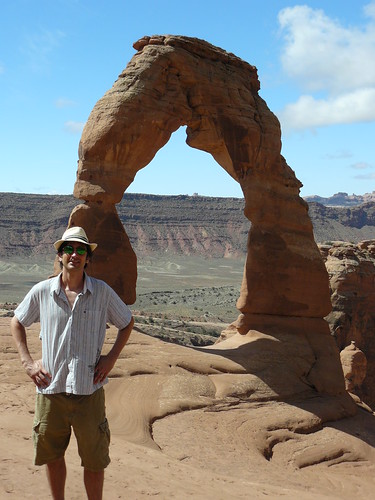
The Fiery Furnace
July 2nd, 2009
While at Arches NP we took a hike through the canyon fins in search of arches. There are no marked trails on the Fiery Furnace walk, nor are there any trail maps to lead you through the sandstone labyrinth. We took a 3 hour guided tour with a ranger, and although it wasn’t a tough trail, it was enjoyable.
118 degrees! That’s hot.
June 30th, 2009
Devil’s Garden Campground
June 28th, 2009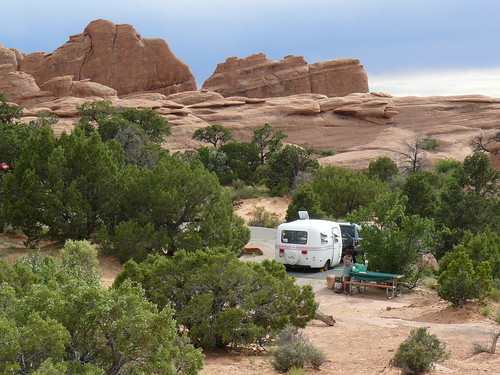
What an incredible location! This is the Devil’s Garden Campground inside Arches National Park. There are only 20 sites or so that are first come first serve.
Rifle Falls, Colorado
June 28th, 2009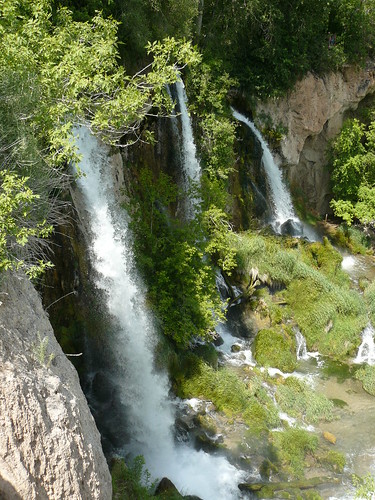 This campground offers both rv sites and tent camping. Tent camping is located off a trail and is private. If you are tent camping, this is the place to do it. There are several trails that surround the campground. They are all easy, short hikes.
Steamboat Springs Lake
June 28th, 2009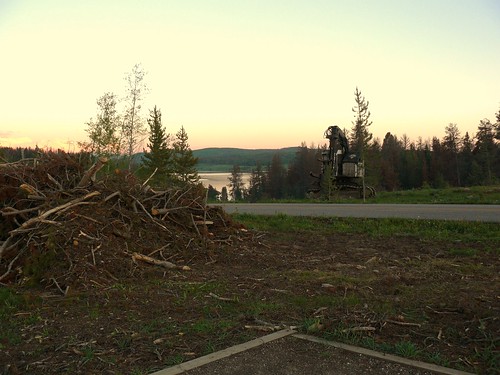
The above photo was much of our view of the lake. Sadly, the mountain pine beetles have done their damage on the pines at Steamboat Springs Lake. The park is in the process of cutting down the dead trees, and are planning to replant 18o0 trees this year. The loss of the trees also means, there is little shade or shelter. We stayed two nights; our first evening we got drenched in a hail and rain storm, and the temperature dropped to 36’F.
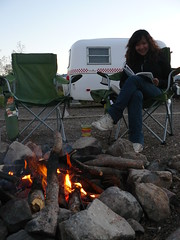 The morning however, turned out to be sunny and beautiful. We spent the day fishing without any luck. The night would have been perfect, if not for the swarms of gnats everywhere.
Visting with family
June 28th, 2009 Before we officially set off for our camping adventure, we stopped off in Fort Collins, Colorado to visit with my brother’s family. It was filled with non-stop activities that Kyra and Aiden are involved in…swim meets, tennis practice, soccer games and baseball games. The week culminated with a pinata party, as Kyra also turned 8 years old and celebrated with 10 of her closest girlfriends.
We wrapped up our visit with family by camping in the Poudre River at the Big South campsite, a small campground, about two hours northwest of Ft. Collins. The Big South is situated between the Cache La Poudre River on one side, and the main road on the other. Eventhough camping road-side doesn’t sound appealing, this campsite still offers a good amount of privacy once it got dark.
Around the world…in the good ol’ USA
June 11th, 2009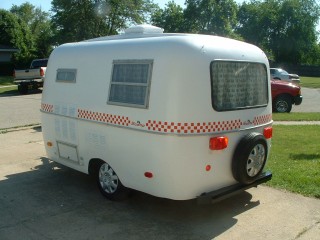 It’s hasn’t been that long since we’ve been back home following out trip around the world, but we’ve gotten the summer travel bug. So we’ve decided it’s time to start our next adventure and explore the great American Southwest. Concentrating on the Four Corner States, we’re planning on hitting Colorado, Utah, Arizona and New Mexico over the next few months. We’re looking forward to seeing some of the U.S.’s best national parks like Zion, Bryce, Arches and the Grand Canyon.
We were planning on tent camping until Christine found these great little Scamp travel trailers while browsing eBay. Neither of us had ever seen one of these before, but aparently they were quite popular in the 70s. Check out the Fiberglass RV website to see some cool pics of all kinds of small vintage RVs. Only 13′ long and made out of fiberglass, they weigh just over 1000 pounds and are very easy to tow. We found a guy in Illinois who renovates these little guys and are now the proud owners of a vintage 1978 Scamp travel trailer. Fitted with a small stove, fridge and AC, we won’t exactly be roughing it, but we’re looking forward to being self contained as we go back on the road.