Archive for August, 2008

back in the USA

Friday, August 22nd, 2008

Two days shy of 13 months on the road, we made our way back to the US, and back to Philadelphia attempting to settle back into some sort of routine.  It’s difficult to try to summarize the last year…it was obviously the opportunity of a lifetime–traveling, sightseeing, meeting new people, understanding other cultures, taking a year off from work, and spending lots of time together.  But how do I wrap up the year in a nice little package that sounds witty and yet profound–I’m not sure it’s possible.   Instead I will leave you with a few of my top ten…

TOP TEN PLACES:
Okavanga Delta, Botswana
Patagonia (El Calafate/ El Chalten/ Torres del Paine)
Bulungula, South Africa
Bazaruto Archipelago, Mozambique
Petra, Jordan
Galapagos, Ecuador
Tofo, Mozambique
Pammukale, Turkey
Molunlong, Lesotho
Salar de Uyuni, Bolivia

TOP TEN CITIES:
Cape Town, South Africa
Istanbul, Turkey
Barcelona, Spain
Buenos Aires, Argentina
Oaxaca, Mexico
Cinque Terra, Italy
Cagnes Sur Mer, France
Havana, Cuba
Dubrovnik, Croatia
Cartagena, Colombia

Top 10 things to bring:
mosquito repellent
pony-o’s
afterbite
Lonely Planet travel book
Blackberry with international data plan
flashlight
a knife
a book
more money than you think you need
an open mind and plenty of patience to live/travel at a slower pace in order to appreciate every moment.
Havana, Cuba

Thursday, August 21st, 2008

Havana-9
Tourism is a big industry for Cuba.  Thousands of Europeans and Canadians visit every year, but US citizens can not.  Technically, it’s not illegal for Americans to go to Cuba, they just are not allowed to spend any money in the country.  This sounds a bit crazy, but it’s one of the ways the US government tries to keep American dollars out of the hands of the Cuban government.  Cubans, however, do not discriminate between tourist dollars.  In Cuba there are two systems of money; the Cuban peso (or CUP) is the currency used by Cubans, and the Convertible Cuban peso (or CUC) which is used by tourists and those Cubans in the tourism industry.  One CUC = 24 CUP= 1.34 Euros= .80 US Dollars.  When traveling to Cuba, bring any currency other than the US dollar, as there is a 10% tax for exchanging dollars.   Even though the typical Cuban makes about $20 dollars/month, it’s not cheap to travel in Cuba due to the Convertible Cuban Peso exchange rate.  Lodging at hotels are expensive, and the cost of transportation is exorbitant.  Bus travel to and from destinations is costly, but even more so are taxis within the city limits.

Maybe 5 or so years ago, the mojito drink made its way into mainstream American bars and restaurants, ushering in a whole new cuisine to go with the drink.  We must have talented chefs in the US because Cuban food is delicious in America, but not in Cuba.  There is little variation available in Cuba–rice, black beans, cabbage salad, and fried chicken/fish/beef.  And no spices–not even salt and pepper.  I found Cuban food to be very bland, and after a week of eating the same thing, we had to break up the monotony and eat pizza at El Rapido, Cuba’s fast food chain.

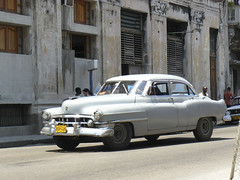
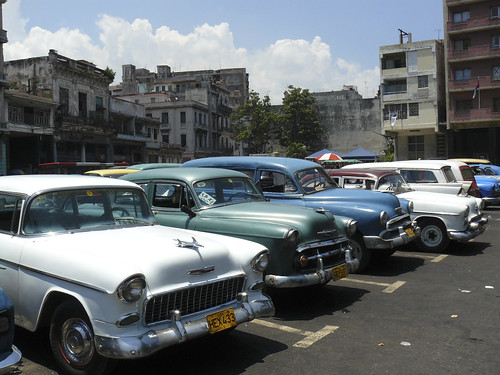
Havana-11 Classic cars in Havana-3
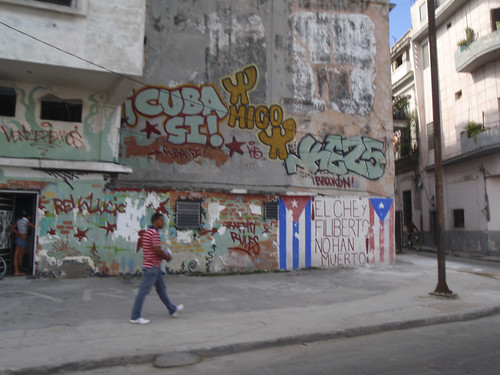
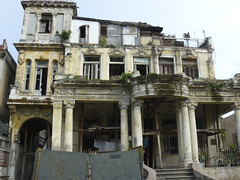
As I mentioned in a previous post it was suffocatingly hot, I was delirious from the heat–making sightseeing and anything related to being outside unpleasant.  But we suffered through the heat, and walked around Havana, an ethnically diverse city and the largest city in the Caribbean at 2.5 million people.   Regardless of their dire straits, Cubans aren’t bothered by much, they live life to its fullest–dancing and celebrating where-ever and when-ever they can.  Grand buildings and colonial homes built during the height of Spanish rule can be seen as a reminder of the grandeur that was once Cuba.  These buildings, regardless of missing a ceiling or an exterior wall, are fully occupied.  It’s not uncommon for 3 generations of the same family to be living under one roof.  The houses crumbling, the vintage cars stalling, and the people really just living in the moment bring feelings of nostalgia for the past, despair for the present and hope for the future.

Trinidad, Cuba

Wednesday, August 20th, 2008

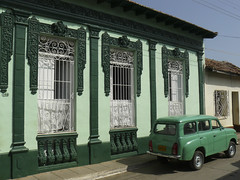
Trinidad Old car and matching house in Trinidad
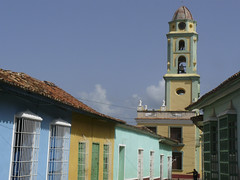
From Vinales, we headed back to Havana then onto Trinidad, about six hours southeast of Havana.  It’s a small colonial town first settled in the 1500’s.  It wasn’t fully until the 19th century when Trinidad was at it’s peak providing sugar to most of Cuba.  Unfortunately, Trinidad did not continue to flourish, and the once beautiful colonial buildings have fallen into disrepair.  Trinidad is also on the tourist path, and live music and dancing takes center stage every evening in the Plaza Mayor.  Here the locals mix with the tourists teaching them how to dance.

Plowing the fields in Vinales

Wednesday, August 20th, 2008

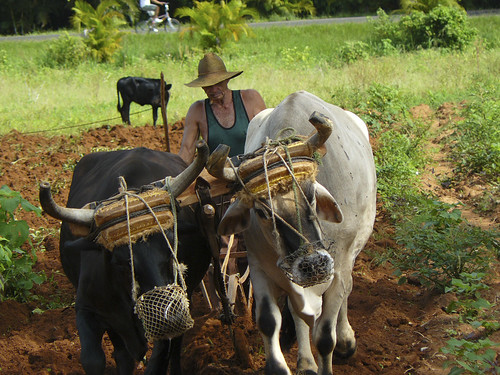
Plowing the fields in Vinales

We side tripped out of Havana to Vinales, a three hour bus ride southwest.  It’s a small town with one main road, a main square with a church.  There are nearly as many tourists as town people, and most of the Cubans are in the tourist industry.  Groups of people meet you at the bus stop selling a room for the night.  Almost every house off the main road looks identical, and each has been converted into a casa particulare, a room for rent in a house occupied by a Cuban family.  Because there are very few hotels in Cuba, many tourists stay in casas particulares.  We stayed at Casa Rosa, complete with air conditioning to battle the heat.  During the day the temperature was in the 90’s and humid.  Probably the hottest place we’ve been–ever.

The ‘Vinales Tour’ the next day brought us to all the best sights in the area; starting with view point overlooking the valley, a primitive mural of evolution painted on the side of a rock, a visit to a cave, and my favorite, a visit with a local farmer.
The farmer we met ‘owns’ four hectareas of land which has been in the family for four generations.  The farmer is completely self-sustaining with his fields of potatoes, taro, corn, sugar cane, rice.  He also grows avocados, tangerines, oranges, mangos, and coffee beans (which is left out to dry for months, and is very, very  strong coffee).   Lastly, each farmer by law is required to grow a minimum amount of tobacco.  November to April is the only growing season for tabacco, the government buys the dried tobacco leaves for $600 dollars for 3 tons of tobacco (or something insane like that).  Since there is no private industry, the government owns everything, including the tabacco industry which is one of Cuba’s largest money generators.  So, it buys the tabacco from the farmers at a favorable price for itself, barely covering the cost of the labor for the farmers, and sells it’s Cuban cigars for huge profits.

Carnivale. Not just for Rio.

Wednesday, August 20th, 2008

Carnival in Havana-2

Havana, Cuba

Wednesday, August 20th, 2008

Classic cars in Havana-6
From Puerto Escondido we flew to Mexico City, Cancun, then into Havana.  With the layovers, it took the entire day before we finally arrived at around 10pm.  After customs and immigration, we got into a taxi, and found the driver had to push us before he could throw the clutch into gear, and we could get going.  But just as we were exiting the airport, the police pulled us over.  It’s illegal to use your cell phone while driving in Cuba, and our taxi driver was reading my phone for directions to our homestay.  After 20 minutes of waiting, the driver returns, but by this time the car has overheated.  The driver pours water over the radiator, and finally 10 minutes later we are off!  Taxis are mostly old Russian Lada cars probably from the 1960’s–that combined with American cars from the 1950’s make up the majority of cars in Cuba.  Most of them need restoration, and although they constantly breakdown most Cubans have found a way to keep them on the road.

market days

Thursday, August 14th, 2008

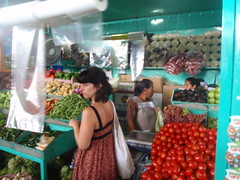
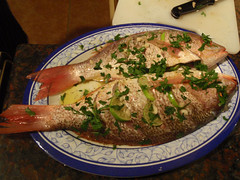
Tracy at the market red snapper ready for our BBQ.  fresh from the local market
Wednesdays and Saturdays are the official market days in Puerto Escondido, when farmers come into town to sell their freshly harvested fruits/vegetables, seafood, poultry, and meat.  We bought avocados, limes, onions, scallions, tomatoes, cilantro, fried tortillas, and soft corn tortillas, pineapple, mangos, red snapper and shrimp.  Our menu:  fresh guacamole, with crispy tortilla chips.  Fresh fruit drinks made in a blender and spiked with rum.  Grilled whole red snapper with olive oil, cilantro, garlic and lime; shrimp with garlic and oil, baked potatoes and grilled scallion.  It was all so delicious, we made the same dinner a few nights later.

surfing in Puerto Escondido

Thursday, August 14th, 2008

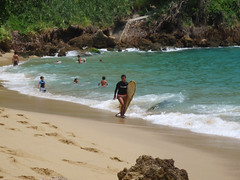
Christine returning from surfing The famous “Mexican pipeline” is found on Zicatela beach, the number three surf location in the world, which are huge waves that form a tube when breaking.  Only advanced surfers dare to challenge the monster waves which can easily snap a surfboard in two.  We went to watch, and, man, the waves towered over the surfers– that’s how big the waves were.  I’d also read that the undertow can be so strong that people have been swept out to sea when only standing ankle deep in water.  I didn’t want to take any chances, and kept away from the waters altogether while we were at Zicatela.
With that said we went to Playa Carranzilillo to surf.  The waves at Playa Carranzilillo are nice and easy, rarely breaking.  I was sharing the waters with other beginner surfers, so it was tough to catch many waves.

sea turtles mating

Thursday, August 14th, 2008

Mike giving the turtles some privacy
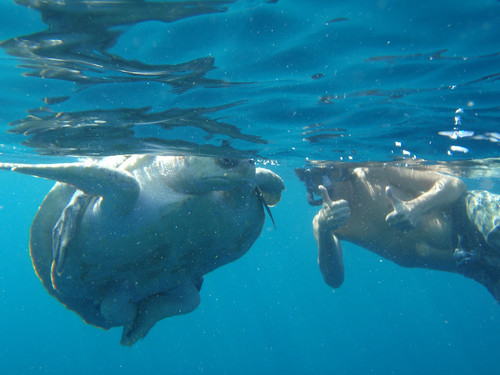
Eleven of the 12 species of sea turtles can be found in the waters just south of Puerto Escondido.  Nesting season is between July – September, which means mating season is around that same window of time.  We hired a boat to take us dolphin and sea turtle watching, and snorkeling.  What we didn’t realize is that we would be intruding on the sea turtles mating.  We saw a ton of turtles, and pretty much all of the turtles we saw were in the process of mating.  Many were shy, and once they spotted the boat, “disengaged” and swam away.  But there was one couple who didn’t seem to mind when we got in the water to swim with them.

Dolphins road along side the boat for a while, and off in the distance we saw a giant sailfish jump out of the water and spread its top fin.

Puerto Escondido

Thursday, August 14th, 2008

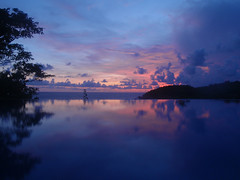
Our infinity pool in Puerto Escondido at sunset The road conditions and the mountains make traveling through Mexico long and tiresome. From Oaxaca, a bus took us south to Puerto Escondido a beach town on the Pacific known for its surfing, and the location where we would meet Tracy for the week.  Only 130miles, but 6 hours by bus.

We rented an amazing house with an endless pool on a cliff above Manzanillo beach with a view over Angelito beach.  It’s hard to imagine after a year of being on vacation that we would need a break from traveling, but a week without planning each day and the following week sounded perfect to us.

bbq in mexico

Saturday, August 2nd, 2008

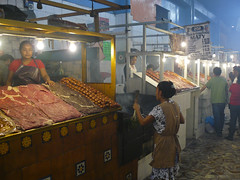
Grilled meat market As we were passing by the mercado Noviembre 20, we noticed huge billows of smoke coming from inside.  We walked in to a meat market and discovered you could pick your meat and eat it right there.  Each butcher stand was equipped with a grill and prepared to cook up a meat-feast.  With the smoke cover and people vying for your business, it was a bit overwhelming, but we managed to get a table.  We had spicy pork, beef, and spicy sausage with sides of guacamole, salsa and grilled scallions.  It was all delicious, until 12 hours later I ended up in the bathroom for the next 24 hours.