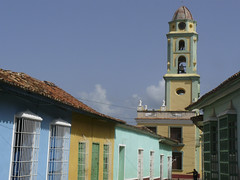
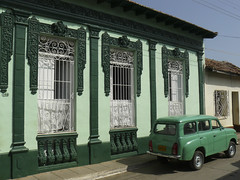
From Vinales, we headed back to Havana then onto Trinidad, about six hours southeast of Havana. It’s a small colonial town first settled in the 1500’s. It wasn’t fully until the 19th century when Trinidad was at it’s peak providing sugar to most of Cuba. Unfortunately, Trinidad did not continue to flourish, and the once beautiful colonial buildings have fallen into disrepair. Trinidad is also on the tourist path, and live music and dancing takes center stage every evening in the Plaza Mayor. Here the locals mix with the tourists teaching them how to dance.
Archive for August 20th, 2008
Trinidad, Cuba
Wednesday, August 20th, 2008Plowing the fields in Vinales
Wednesday, August 20th, 2008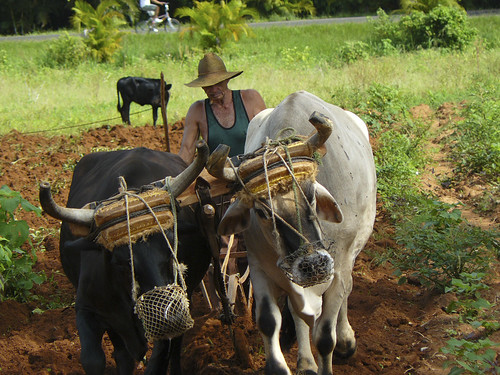
We side tripped out of Havana to Vinales, a three hour bus ride southwest. It’s a small town with one main road, a main square with a church. There are nearly as many tourists as town people, and most of the Cubans are in the tourist industry. Groups of people meet you at the bus stop selling a room for the night. Almost every house off the main road looks identical, and each has been converted into a casa particulare, a room for rent in a house occupied by a Cuban family. Because there are very few hotels in Cuba, many tourists stay in casas particulares. We stayed at Casa Rosa, complete with air conditioning to battle the heat. During the day the temperature was in the 90’s and humid. Probably the hottest place we’ve been–ever.
The ‘Vinales Tour’ the next day brought us to all the best sights in the area; starting with view point overlooking the valley, a primitive mural of evolution painted on the side of a rock, a visit to a cave, and my favorite, a visit with a local farmer.
The farmer we met ‘owns’ four hectareas of land which has been in the family for four generations. The farmer is completely self-sustaining with his fields of potatoes, taro, corn, sugar cane, rice. He also grows avocados, tangerines, oranges, mangos, and coffee beans (which is left out to dry for months, and is very, very strong coffee). Lastly, each farmer by law is required to grow a minimum amount of tobacco. November to April is the only growing season for tabacco, the government buys the dried tobacco leaves for $600 dollars for 3 tons of tobacco (or something insane like that). Since there is no private industry, the government owns everything, including the tabacco industry which is one of Cuba’s largest money generators. So, it buys the tabacco from the farmers at a favorable price for itself, barely covering the cost of the labor for the farmers, and sells it’s Cuban cigars for huge profits.
Carnivale. Not just for Rio.
Wednesday, August 20th, 2008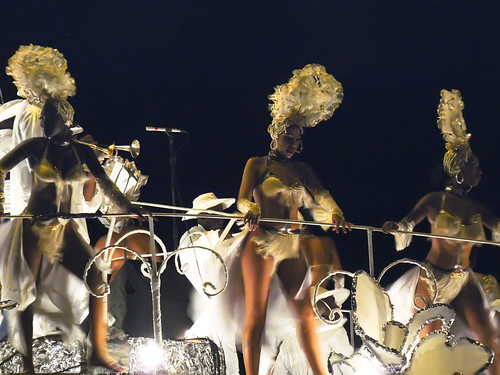
Havana, Cuba
Wednesday, August 20th, 2008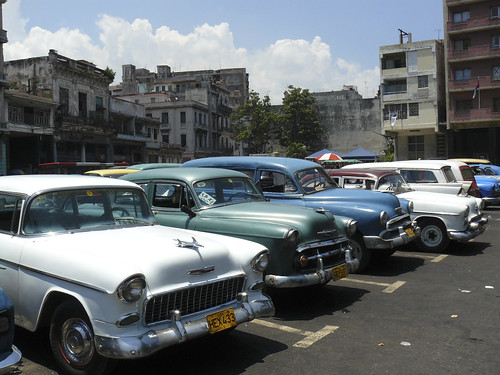
From Puerto Escondido we flew to Mexico City, Cancun, then into Havana. With the layovers, it took the entire day before we finally arrived at around 10pm. After customs and immigration, we got into a taxi, and found the driver had to push us before he could throw the clutch into gear, and we could get going. But just as we were exiting the airport, the police pulled us over. It’s illegal to use your cell phone while driving in Cuba, and our taxi driver was reading my phone for directions to our homestay. After 20 minutes of waiting, the driver returns, but by this time the car has overheated. The driver pours water over the radiator, and finally 10 minutes later we are off! Taxis are mostly old Russian Lada cars probably from the 1960’s–that combined with American cars from the 1950’s make up the majority of cars in Cuba. Most of them need restoration, and although they constantly breakdown most Cubans have found a way to keep them on the road.