Archive for July, 2008

Steaming tamales Reading history section of each country in our guide book can sometimes be boring.  And I will admit, I have been known to skip it entirely.  But the one part of the travel guide that I never skip is the food chapter.  Mostly I highlight and take notes on what I’d like to try while in said country.  For Mexico, I actually made a list of things not to eat.  I wrote down the Spanish name so I wouldn’t order it by mistake.  My list was chapulines (grasshoppers), gusanos (worms), huitlacoche (black fungus grown on corn).  Seems easy enough to avoid…

Oaxaca is known for its culinary traditions, and I wanted to learn more about it.  So I signed us up for two different classes.  Our first class was with Pilar at La Casa de los Sabores.  Before we started cooking we headed to Mercado Democracia to buy our fresh ingredients…mangos and watercress for our salad, yerbasanta leaves, corn husks, banana leaves, squash blossoms, huitlacoche, and corn masa to make tamales.
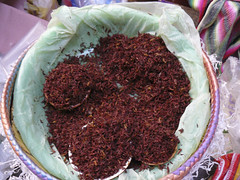
Chapulines, (dry roasted, spiced grasshoppers) Going to the market is one of my favorite things.  I love to look at local fruits and vegetables, the cheeses and meats.  But going to the market with an expert like Pilar makes the experience even better.  It also makes it easier to taste foods you may normally not eat–after all if the chef is eating it, it can’t be that bad.  Pilar seemed pretty excited that chapuline/ grasshopper season had just started.  Grasshoppers are sold in a variety of sizes, but the baby ones are the freshest and taste the beat.  The grasshoppers are boiled then mixed in a salty concoction and eaten like any other snack, by the handful.  To me, it tasted like dried salted shrimp, kind of like smelly fish.
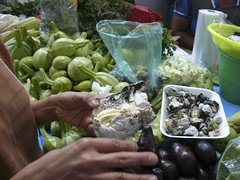
huitlacoche (corn fungus) After our market experience, we headed back to the kitchen to get working on our menu–a fresh jicama/mango watercress salad, three types of tamales, spicy salsa, and a mango mousse.  There were eight of us in the class, and we worked as a group on each of the courses.  The tamales were chicken with black mole, bean with yerbasanta leaf, and squash blossom with huitlacoche (black fungus).  I love mushrooms, but I was weary of the corn fungus.  But mixed into our corn tamales, it was actually hard to detect much of a taste.
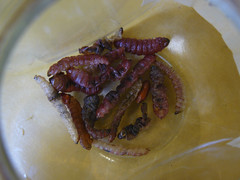
gusano (worms to be ground up into our salsa) Lastly, we made spicy salsa with gusano worms crushed in for added flavor.  It turns out Mexicans have a long history of eating insects, mostly because they did not have many domesticated animals, so as an alternate source of protein they ate insects.  The gusano worm is the same worm found at the bottom of a bottle of Mezcal.  They are white, pinkish or red in color.  We ground up the worms in a mortar and pestle along with the rest of the ingredients for the salsa.  I can’t exactly describe the flavor of the worms–smokey?? But I didn’t like the flavor of the salsa.  Maybe it was because I knew there were worms in it.

I fully enjoyed learning to cook from Pilar, it was a great experience.  Somehow she had my secret list of things not to eat, and I tried them all.  When in Rome…
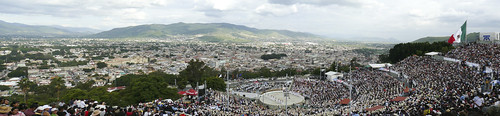
Oaxaca panorama from Guelaguetza
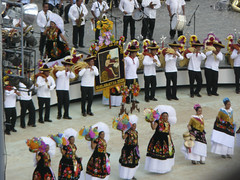
Oaxaca, located a few hours east of Mexico City, has a population of almost a half million people but it feels like a lot more than that.  Mexicans from all over the country come to the month long celebration of Guelaguetza.  In pre-Hispanic times, the festival was to honor maize and the wind gods.  Now days, it’s a folk festival and a celebration of the Virgen del Carmen.  We just happen to be staying right in front of the Iglesia del Carmen Alta, where street vendors are lined up outside our place selling empanadas, memeles, embaradas, tostadas, ice cream, pancakes, corn, jimica, etc.  Along with the food, there are carnival rides, giant puppet dances, firework displays, and music plays from morning to night.
Guelaguetza-3 The main event during the month is the Guelaguetza on the Lunes del Cerro, located in an ampitheater overlooking Oaxaca.  Traditional dance and music representing the seven regions of Oaxaca are celebrated.  It is held every year on the first and second Monday after July 16th.  It’s a three hour event, in theory.  But it’s necessary to arrive early in order to attempt to get a seat.  Mike and I left two hours early in an attempt to get one of the free seats, but ended up smashed up against other people waiting to get in.  Finally after three hours of almost no personal space, we got in.  Standing room only.  But for the hour we watched, the dances were beautiful, as were the costumes.

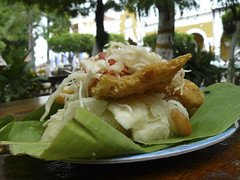
vigaron, a Granada specialty Vigaron, a local specialty of Granada, looks to be that perfect summer meal topped with fresh cabbage, tomatoes, and served up on a banana leaf.  But if you look more closely, you’ll see this dish comes complete with chicarrones (or fried pork rind), boiled yucca, thai peppers, and dressed with vinaigrette.  This is definitely a case where looks can be deceiving.

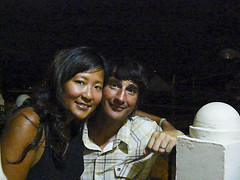
one year on the road Well, we did it!  Officially, we have been traveling one year.  This last year, we’ve had incredible adventures, seen some amazing places, met friends & made friends along our travels.  We’ve braved the unknown, tried strange and delicious foods, and most of all, we now know more about each other than we thought was possible.  

We marked this anniversary by taking a boat tour of the Isletas de Granada (little islands), and a nice, casual dinner at our hotel in Granada. 

.

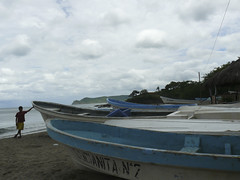
Playa Gigante, a fishing village After crossing the border into Nicaragua, we hopped on an old converted school bus headed to the beach.  Just north of San Juan del Sur is a small village called Playa Gigante.  The population is about 500 and growing.  Originally struggling as a fishing village, new foreign investors are starting to bring tourism to the area.  Playa Gigante isn’t an ideal surf location, but a short walk or boat ride will take you to great waves.  And that’s enough reason for the avid surfer to arrive, maybe not in droves, but enough to make a difference.

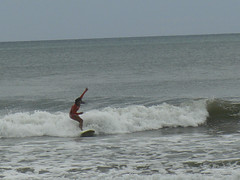
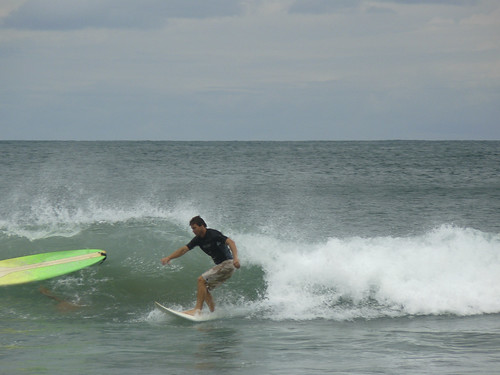
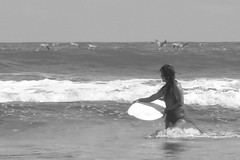
surfing in Playa AmarilloWe met back up with Hedda & Michael Hagen for the week, and Michael Hagen has been teaching us how to surf on Playa Amarillo.  Other than a few unused shelters built on the beach, Playa Amarillo is completely undeveloped–no boats, houses or restaurants.  The last two days the four of us have had the beach completely to ourselves.  Since I’m just a beginner surfer, I can’t speak for the quality of waves in Nicaragua, but a beautiful sandy, deserted beach anywhere in the world is a real jewel.

Michael surfing while I'm underwater
Since I’ve skied all my life, learning to surf seemed like it should be easy, but it’s not.  The toughest thing about surfing is not tiring yourself out while paddling out past the waves crashing down.  The waves keep breaking; even as I get past one, there’s another one and another one, as if they multiply.   As I try to dodge the white water, I’m kind of panicked, thinking “oh shit,” “oh shit”…if a wave crashes down on me, I’m thinking something way worse than “oh shit”…by the time I make it out past the waves breaking, I’m completely relieved and exhausted…while I wait for a set to roll in, I try to catch my breath…when the time is right, I try not to get frantic as I start paddling against the wave thinking, “hurry, hurry, paddle faster!”…as the wave takes me, “yeah, here we go!”…if I get to my feet, I’m elated thinking, that wasn’t so hard, along with “whoa, this is excellent!”.  If I didn’t make it to my feet, I’m holding my breath underwater wondering when I will be released from the grips of this mighty wave and wondering whether my surf board is going to knock me out.  It’s obviously going to take time to get it right–but it’s the right combination of challenging and rewarding to keep me going back for more. {above: Michael Hagen surfing.  Look closely and you can see a blur of orange under the wave.}

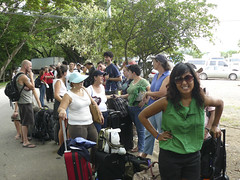
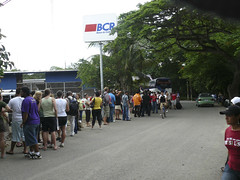
After waiting 2 hours to cross the border.. Border control between Costa Rica and Nicaragua.  Be prepared to wait at Penas Blancas
Over the last year we’ve been to close to 40 different countries.  Entering the country by plane, bus, car or foot, customs and immigration in most countries have been hassle-free, and expedient.  This is not the case at Penas Blancas, the border between Costa Rica and Nicaragua.  We spent two hours waiting in line just to leave Costa Rica–I guess the customs officials were on lunch break.  The Nicaraguan side only took about 20 minutes.  We were lucky, though, as Hedda & Michael crossed at Penas Blancas the next day, their wait was 2.5 hours in Costa Rica AND 2 hours in Nicaragua.

In search of sea turtles nesting, Mike and I caught a bus to Samara from Nicoya.  There are several nesting beaches on the Nicoya Peninsula where turtles come to lay their eggs.  The best time is during the “arribadas” when thousands of olive ridley sea turtles make their way to the shore.  So many turtles are nesting at the same time, it’s possible a turtle might dig up the nest of another turtle because the beach is full of eggs.  The arriabadas occur between July and November, but it’s about being lucky, as no one can predict when this will happen.

olive ridley sea turtle nesting in Costa Rica On a typical night between July and November a few turtles may come to nest, not thousands.  Our tour took us to Playa Camaronal beach where four species of sea turtles are known to nest: olive ridley, hawksbill, leatherback and black turtle.  Any sort of bright light will keep the turtles from coming ashore, so from 8pm to 9pm we combed the beach in complete darkness with out finding even one turtle.  Our group was starting to give up hope of seeing a turtle, but our guide persevered.  Finally, at 10pm, a teardrop shaped olive ridley turtle came ashore, and began her nesting ritual.

All turtles instinctively know where to lay their eggs–returning thousands of miles to the exact beach where they were born.  The olive ridley laboriously makes her way up the beach to lay her eggs.  She then uses her hind flippers to scoop out an appropriate sized hole for her eggs.  Once this is completed, any where from 100-130 ping pong-sized eggs are laid.  Again using her hind legs, she covers and neatly buries the eggs.  She then disappears back into the ocean.  The entire process lasts about one hour, and it’s pretty amazing to watch.

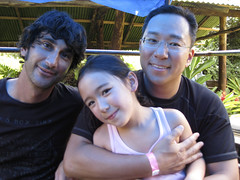
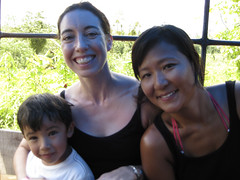
family shotfamily shot-2
The week in Costa Rica with my brother and his family just flew by…But not without a few things that I can’t help but find funny.  And I want to share them…
1.  I’ve heard teenage kids sometimes call their parent by their first name as sort of a rebellious/ I’m independent kind-of-thing, but I’ve never heard a 7 and 5 year old do it.  Kyra and Aiden were a bit confused by the fact that there are two “Mike’s”.  And on many occasions last week, this led them to call their dad, “Mike,” rather than “dad”.  I was reassured that this was the first time it’s ever happened, but personally, I found it really funny.
2.  If you have been reading our blog this last year, you’ll know that I just learned how to swim.  What you might not know is that non-swimmers run in my family.  My dad is a great swimmer, but my brother and my mom aren’t.  Now, what’s funny about this is that my brother’s kids are swimmers.  Kyra is on the swim team, and Aiden plans to join next year.  Kyra knows all the strokes, and they can both swim for hours in the pool.  Which brings me to the point…Kyra and Aiden made endless jokes and demonstrated how my brother(their dad) swims doggie paddle!

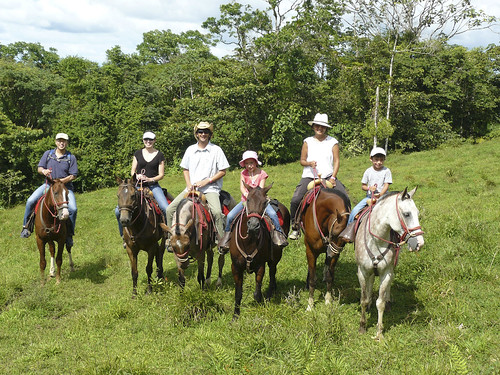
The gang horseriding-3

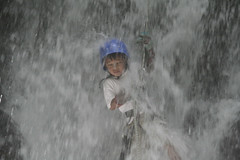
From Santa Catalina in Panama, it took us two days of buses to reach San Jose, Costa Rica where we met Mike, Rachel, Kyra and Aiden.  We drove from the airport out to the La Fortuna to tour around the Volcano Arenal for three days. In those three days, we went zip-lining above the canopy of the rainforest, horse back riding where we spotted toucans, sloths and snakes, and canyoning, repelling down cliffs and waterfalls.

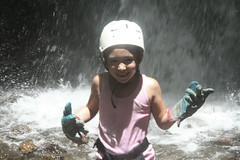
Kyra canyoning-5 Aiden canyoning-3
It’s been a year and half since we’ve seen my brother and his family. Kyra and Aiden have grown up to be wonderful little kids with big hearts and a strong sense of adventure. They were fearless on all of our activities. They loved all of them equally, saying “it was awesome.” Really amazing for only being 7 and 5 years old.

It was a busy three days, but since then we’ve driven north to Playa Conchal where there is little to do, but sit by the pool enjoying refreshing strawberry daquiris. 

Today is the 4th of July and it’s nice to be here with family…it also makes me think about when my brother and I were kids…to celebrate independence day, we would light sparklers and race each other around the house as many times as we could before the sparklers would go out.  Maybe I’ll see if my brother is up for the challenge tonight…

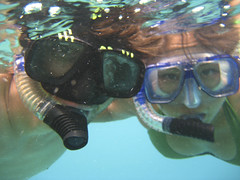
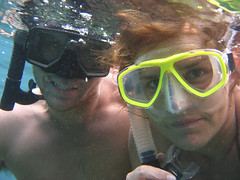
Snorkeling  Hedda and Michael Snorkeling
About an hour by boat from the Santa Catalina is Coiba Island, a former penal colony between 1919-2004.  Since it’s closure as a prison, the island has been declared a world heritage site, due to its many plants and animals that are endemic to the island.  We spent the day snorkeling with sea turtles, white tipped sharks and other amazing underwater life.  This was some of the best snorkeling we have seen.

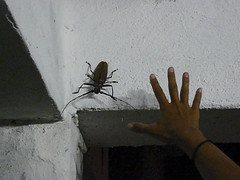
This insect flew into Christine's haira giant bug landed on your head…and all you felt was the weight of it land, and it’s claws clamp onto your scalp??
According to Hedda, I was pretty calm about the whole thing.  But it took a lot of self control not to shake my head wildly trying to rid myself of this nasty creature. 

Surf's up

With Michael and Hedda, Mike and I ended up in a highly enviable position for anyone who might surf.  Of course, we don’t but got to see first hand what it’s like to be at a prime surf location.  Santa Catalina is pretty rustic with no “real” hotels, and very few restaurants, but people come for the waves.  We spent 4 nights enjoying the unspoiled beaches.  Michael did some surfing, and even spent a day teaching Mike and I how to surf.  It was a blast– although not exactly as easy as Michael makes it look.

Panama Canal-2From Cartagena, we (Mike, Michael and Hedda) flew to Panama City to see an engineering wonder of the world, the Panama Canal.  The 48 mile canal connects the Atlantic and Pacific Ocean, eliminating the need to travel an additional 8000 miles to round Cape Horn (the southern point of South America).   Opened in 1914, the canal continues to play an ever increasing role in shipping– expansion plans are underway to increase the capacity of the Panama Canal. 

Aside from visiting the Panama Canal, there isn’t a whole lot to do in Panama City except catch up on newly released movies, eat fast food and visit the mall– and we did all of the above.