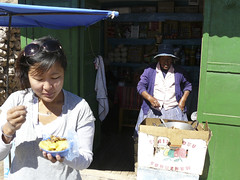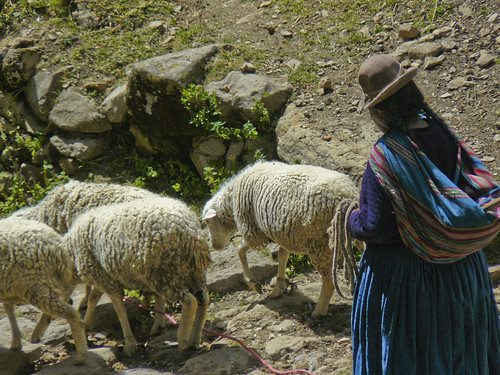
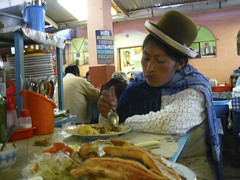
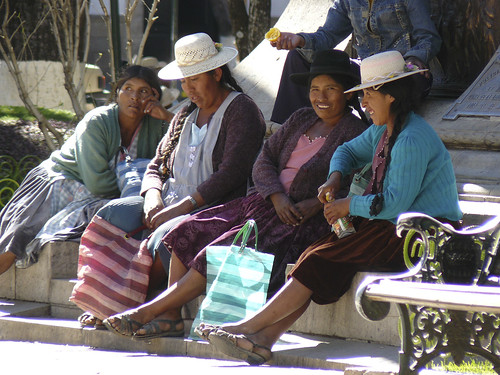
One of the things I like about Bolivia is that the women love to wear hats. It doesn’t necessarily have a purpose, like to shield them from the sun, but their hat is necessary to finish off their “look,” and to me that is the perfect definition of an accessory–I love it.
Actually if you go back in time, the different tribal groups in Bolivia could be identified, not only though their textiles patterns, but also from the style of hat worn. But as recently as 1920, it is believed a shipment of bowler hats was sent from Europe, meant for the Europeans working on the railroad in Bolivia. These hats, too small for the European men, were quickly adopted by the Aymara and Quechua women of Bolivia.
The hat is so out of place that it works with the traditional Bolivian garments. The women wear tiered velveteen skirts with petiticoats underneath. The skirts are typically brightly colored in violets, reds, tangerines, and inky colors. In the south it seemed the perfered length is at the knee, worn with knee-hi socks, but further north, it’s longer, and worn with a hand -crochet cardigan. Also, every Bolivian woman must have a tapestry wrapped around her shoulders either carrying a grandchild or some other bundle on her back. Whether the skirt length is long or short, the bowler hat works for any occasion, even tending the sheep.
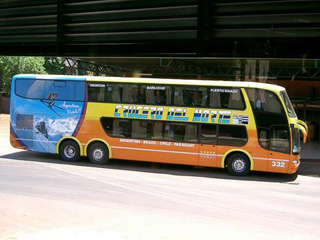 Before Bolivia, our experiences with buses in South America has been pretty good. Sure, spending 15-20 hours on a bus isn’t ideal, but the buses in Brazil and Argentina are really something else. Take a look. It’s a luxury liner. You get meals, drinks, movies, a bathroom and a steward on board. Compared to the Chinatown bus to New York, these buses are like riding on the space shuttle. Check out this animation below, demonstrating all of the seat choices. Premium class turns into a bed. Pretty sweet.
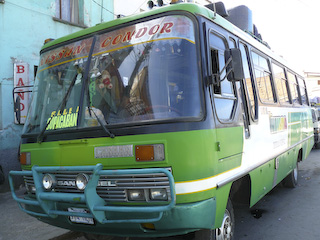 Now this is a bus in Bolivia. Study the photo intently and you may notice a few differences. There’s no need for an animation depicting the various seat choices because there are no choices. In fact, you don’t even need a seat. They will sell you standing room…on a 10 hour overnight trip! Our ride from Uyuni to Sucre had 40 seats, and 55 passengers. People standing and sleeping in the aisles, sitting on each other’s laps…the only thing missing was livestock. Somehow we managed to get a few hours of sleep despite the bumpy ride. (only 5% of roads in Bolivia are paved)