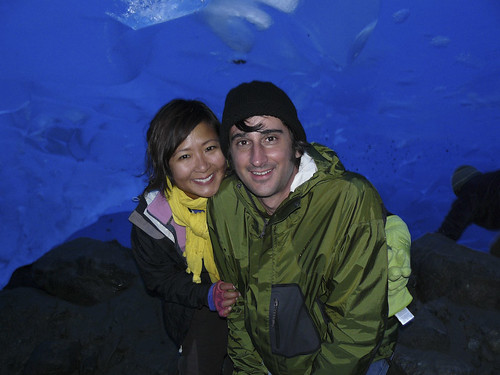
We found our new house, our new ice cave at the base of the Perito Moreno glacier. It’s a little cold…
We found our new house, our new ice cave at the base of the Perito Moreno glacier. It’s a little cold…
 The next morning we set off early for our “Big Ice” trek on the Perito Moreno glacier. The Perito Moreno glacier is only one of three glaciers in Patagonia that is not retreating. Depending on the time of year, the glacier is continually advancing and/or retreating. Occasionally we would hear a loud cracking sound, similar to that of thunder, followed a chunk of ice falling off the glacier, splashing into the water. Quite an amazing experience.
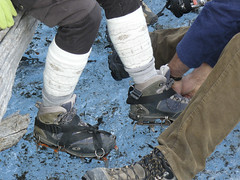
For our trek, we started hiking along the mountainside for an hour alongside the glacier. Before stepping onto the glacier, we had crampons securely fastened to our hiking boots. The trek on the glacier was about 4 hours, and it was one of the highlights of my trip. The crampons ensure a strong grip in the ice even when going uphill or downhill. They made crossing on the glacier surprisingly easy, with the satisfying crunch of ice under-foot.
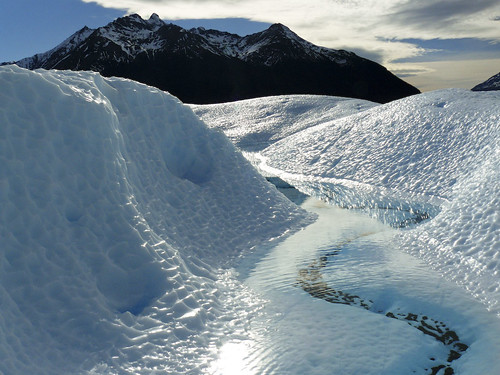
I thought the boat ride was amazing, but even there you can’t see the details of the glacier…there are streams and pools of water running throughout the glacier, along with cracks and crevasses filled with water. Different objects on the glacier (such as rocks, leaves, branches), absorb the sun at a faster rate, creating a depression (called cryocones), which then creates small natural pools and streams that continue to melt at a faster rate than the glacier. A small pebble might be responsible for 30 foot deep pool.
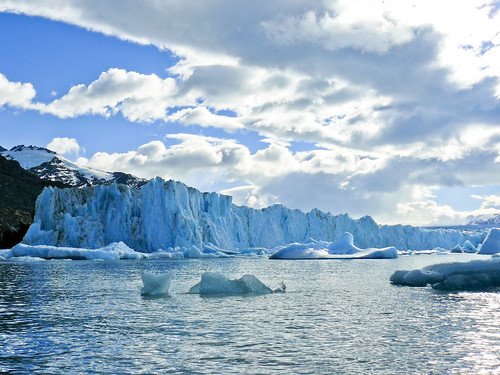
After a week of taking Spanish classes and eating bife de chorizo in Buenos Aires, we flew south to El Calafate to see the mountains and glaciers of Patagonia. Early the next day, even before sunrise we departed by boat from Bandera Port to explore the nearby glaciers–Upsala (the largest in the region), Spegazzini (with the highest front wall @ 400ft) and Agassiz.
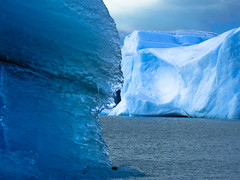 The glaciers in Patagonia are centennial glaciers, existing in the last hundred years, rather than the millennial glaciers of Antarctica (thousands of years old). The glaciers are formed in the Andes mountains–as snow accumulates in the valleys between the mountains, over time the snow becomes compact, forming into ice. The icefields of Patagonia are the source of the world´s third largest freshwater source.
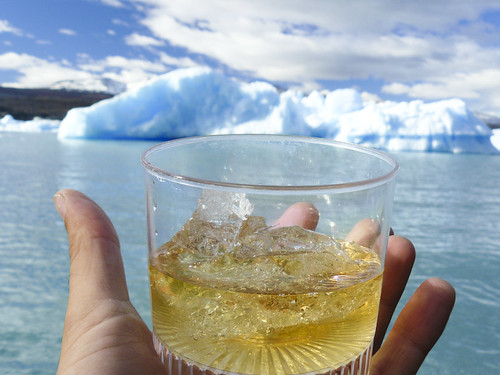
By boat, we were pretty close to the glaciers and icebergs, able to see clearly the beautiful shades of blue reflecting off the sun along with the different textures of each glacier. It was spectacular. At one point the crew, pulled out a chunk of ice floating in the water so we could drink our Nacional whiskey with fresh glacier ice.