Archive for December, 2007

I Wanna Rock!

Friday, December 28th, 2007

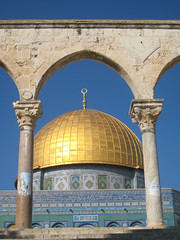
Dome of the RockThis is the Dome of the Rock, the third most holy site in the world for Muslims after Mecca and Medina. This is where Muhammad is believed to have ascended to heaven accompanied by the angel Gabriel. Inside, there is in fact, a rock, that is supposed to have an indentation of both his foot and his winged steed, Buraq, as the angel pulled him up to heaven.

Unfortunately for Jewish people, this is also believed to be the Temple Mount, the site of the 1st and 2nd temples and thus the Holy of Holies. That very same rock is not only thought to be the location of Jacob’s dream of a ladder to heaven, the place where Abraham was going to sacrifice Isaac, and pretty much where any other rock-related story in the old testament happened, it’s also supposed to be the foundation stone for the creation of the Earth! Needless to say, a lot of people want this rock.
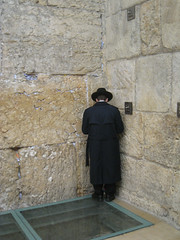
western wallThese days, the ball (or rock) is in the Muslim’s court. In fact the site is off limits to non-Muslims since there’s been quite a few conflicts inside over the years. (Somehow they can always tell we’re not Muslim when we try to go into these sites.) In fact, even if it was open, strict Jewish people are not supposed to enter because no one but the high priest was supposed to enter the Holy of Holies, and not knowing exactly where that was, it’s best to play it safe and keep out of the whole area. So instead they worship at the Western Wall. The Western, or Wailing Wall is believed to be the only remaining remnant of the 2nd Temple and thus the closest Jewish people can get to the holiest site in Jerusalem.
Jesus slept here. Or maybe it was over there…

Friday, December 28th, 2007

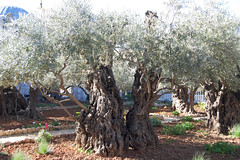
olive trees from time time of the RomansWhen you walk through the old city in Jerusalem you feel like you are walking through history… or at least the Epcot Center version of it. Pretty much every single event in the Bible is accounted for here. You can visit where Jesus stayed the night in the olive garden of Gesthemane before his death, and then later, where He was imprisoned, now a Greek Orthodox shrine. But then you walk down the street a little more and there’s a sign for a different place called Jesus’ prison, this one run by the Armenians. Hmmm…

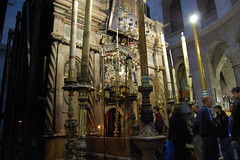
room where Jesus' tomb was located

You can visit the Church of the Holy Sepulchre, which encloses Golgatha, the hill of Calvary where Jesus was crucified as well as the cave where He was buried. But hold on…there’s another spot a little outside of the city walls that also claims to be the spot where these events took place, that one run by the Protestants. Want to walk the Stations of the Cross? You can do that too, but keep in mind they’ve changed that path around numerous times over the years to accommodate the construction and traffic flow.

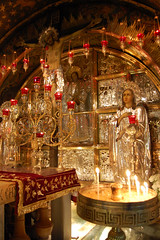
greek orthodox chruch where the crucifixion took placeSo what gives? Basically, all of the holy sites were set up by the first Christian Emperor Constatine’s mother Helena, who built churches 300 years after Christ’s death where many of the events in the Bible were believed to have taken place. These were pretty much all destroyed by the Persians, rebuilt by the crusaders, destroyed by the Ottomans, rebuilt, destroyed etc.. In modern times, all of the different denominations have bought, sold, and renovated the sites and run shrines there. There’s really not much to see, other than a church built on the place they say something important happened. The city was rebuilt so many times, that the current city is built some 50 feet on top of the remains of anything from Jesus’ time. So basically you take everything with a grain of salt. Things may not have happened exactly where they say it did, but it is still interesting to walk around knowing that a lot of those events happened somewhere nearby, and with a little imagination, you can still enjoy walking at least somewhat close to history.

Yanoun Village

Thursday, December 27th, 2007

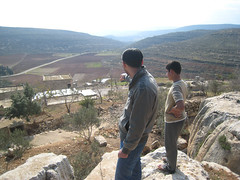
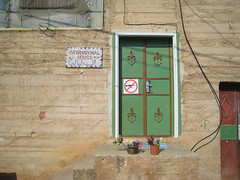
Looking out over yanoun villageWe visited a small village near Nablus called Yanoun. The village has only 9 families living in it and their ancestors have lived there for hundreds of years. In 1996, the village was invaded by fundamentalist Jewish settlers, who wanted the villagers out. They surrounded the villagers in the valley from outposts in the hills and stole their land, poisoned their animals, and beat and harassed the villagers. By 2002, the locals had enough and fled to a nearby town. This was the first time an entire village had been evacuated by settlers and it caused the international community to take notice. They set up an “International House”, where volunteers live 365 days a year to help International house Yanoun villagemake sure no more shenanigans take place. The villagers have moved back but still have difficult lives, always watching over their shoulders, tending to the little land they have left. We spoke with an old woman who invited us for some coffee and told us about getting harassed by the settlers. Her husband was in a wheelchair after being beaten defending his father during a scuffle with them. The young boy in the photo is her son. When our guide Mahmoud asked him if he was fed up living here, he amazingly was not angry about his situation and said “No, it’s not that bad.” He said he could deal with the settlers, because this was his home.

Peace in the West Bank???

Wednesday, December 26th, 2007

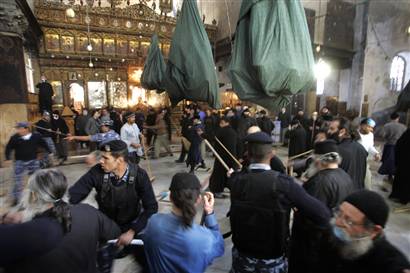
071228-scuffle-hmed-9ahmedium.jpg

How can there be peace when even the priests are fighting about how to clean up the church of the Nativity? More here.

oh, Christmas tree…

Tuesday, December 25th, 2007

Our Christmas tree

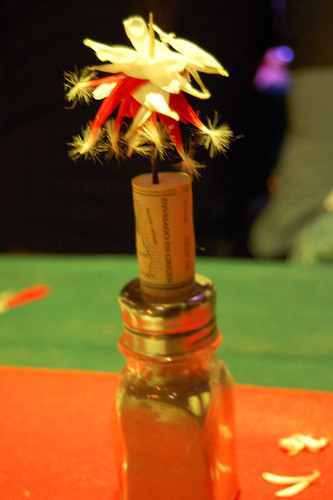
Appropriately, we went to Mike’s Place for Christmas dinner–turkey, stuffing, mashed potatoes, and cranberry sauce. And Mike made us a Christmas tree.

checkpoint

Monday, December 24th, 2007

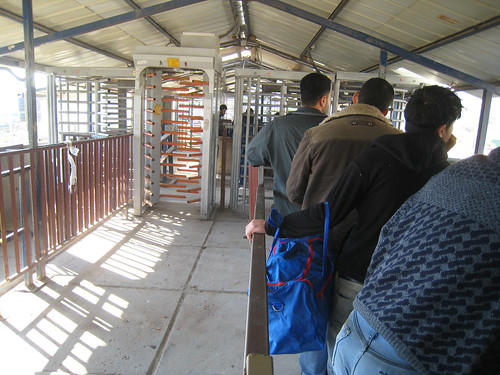
Huwarra checkpoint
The last few days have been very sobering, and I almost feel guilty after having such a good time in Jerusalem, the Dead Sea, and in the north in Galilee. We took a two day tour of the West Bank with a Palestinian guide, Mahmoud, and witnessed first hand the types of restrictions the Palestinians face, daily. During our tour we visited Ramallah, Bethlehem, Hebron, Yanoun and Nablus, which are all Palestinian controlled territories, and are subject to numerous checkpoints. Checkpoints and security checks aren’t a big deal to us; we’ve been through maybe 100 or more between Turkey, Egypt, Syria, and Jordan. But in Israel it’s completely different. In order to go in/out of a Palestinian city, there are check points that are monitored by Israeli soldiers, even though it’s Palestinian territory. The Palestinians are scrutinized at every turn, their IDs are checked; they are humiliated, humbled and basically emotionally berated in their own land. In addition to the permanent checkpoints, there are “flying checkpoint” (checkpoints set up randomly). The young Israeli soldiers are trained to question and interrogate. They are intimidating, serious and seem to be easily angered and offended. While we were in line at the Nablus checkpoint, the soldiers began to yell, because someone was standing “over the line” of where the line should start. All of the people in the cattle coral were told to move back before anyone else would be processed. Because the the Hamas and Fattah movements were centered in Nablus, the city is closed except by two entry/exit points, which makes coming and going out of Nablus difficult. In addition to the security checks, Palestinians are only allowed to travel on specific roads built for the Palestinians. These routes are indirect and require driving around Israeli settlements and make travel difficult and time consuming. The first day our guide was almost an hour late meeting us, because of the checkpoints. Apparently, it took him close to 3 hours, for what should have taken only 30minutes.

Palestinians are forbidden from carrying weapons, but the Israelis carry machine guns–EVERYWHERE. Walking down the street, at a bar, restaurant, in the country, at the Western Wall– EVERYWHERE. If an Israeli settler on Palestinian land feels they need a machine gun for safety, they are given one along with at least one security guard per family.

Creating a situation frustrating enough to make the Palestinians leave or to resume suicide bombings, is not the solution. I certainly have no answers to the situation and frankly, it’s depressing. There are both Israelis and Palestinians who share my point of view, but it is the extremists/fundamentalists that make it impossible for everyone to live together. When the Israeli West Bank Wall is completed in the year 2010 and Israelis and Palestinians are physically separated by a 26 foot high wall, repairing the damage that has been done between the two groups of people will take more than the eight years it took to build the wall.

West Bank Tours, Project Hope & As-Sirk As-Saghir, the Palestine Circus

Monday, December 24th, 2007

Our guide mahmoud We were very impressed by our guide in Palestine, Mahmoud. At 25 he’s lived a rather extraordinary life. He volunteered as a paramedic during the 2nd Intifada and told us many sobering stories of the 22 day siege of Nablus. He led us around the old city and, his voice cracking as he described losing both friends and family members as a result of the fighting. Having seen the horrors of war first hand, Mahmoud now devotes his time to 3 organizations. Project Hope, an organization providing educational and recreational activities for children in Nablus, West Bank Tours, a local tourism company hoping to show people the real Palestine, beyond the sensationalism and headlines, and As-Sirk As-Saghir, a volunteer circus that puts on shows and teaches kids juggling, clowning and performing. He told us his goal is to reach a new generation, helping needy kids find positive outlets growing up in an extraordinary situation.

The West Bank Wall

Monday, December 24th, 2007

[kml_flashembed movie=”/wp-content/uploads/2007/12/westbank.swf” height=”440″ width=”550″ allowFullScreen=”true” /]

Since we were in Jerusalem, we wanted to visit Bethlehem for Christmas. Seemed like the thing to do. Looking at the map it’s close. It’s gotta be easy to get there, right? We could just hop a cab or even walk a bit. Oh wait…look at that. There’s a 26 foot wall surrounding Bethlehem. In fact it’s 436 miles long and surrounds the entire West Bank!!!

Banksy made some headlines recently, creating some artwork on the wall to raise awareness about the situation in Bethlehem. Here’s a slideshow of some of what we saw.

Banksy “decorates” the West Bank Wall in Bethlehem for Christmas

Monday, December 24th, 2007

[kml_flashembed movie=”/wp-content/uploads/2007/12/wall.swf” height=”400″ width=”570″ /]

Here’s a panorama of a small section of the wall.

cheese!

Friday, December 21st, 2007

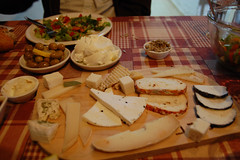
Yummy lunch, Goat cheese farm When you think of Israel, wine is not the first thing that comes to mind. But in the regions of Galilee, Golan Heights and even outside of Jerusalem, wine production is a big thing. Just north of Galilee in a small town called Rosh Pina, we heard there was a cute B&B and wineries, so we headed up there to see for ourselves, and to check out some biblical sites, of course.

Somehow we actually never made it to any of the vineyards, but we did manage to try a number of wines at our B&B. And we did go to Ein Kamonim, a farm that specializes in goat cheese. This lunch really hit the spot. I can’t remember the last time I had wine and cheese, which is one of my favorite things. The cheese was all produced right on the farm.

dead man’s float

Thursday, December 20th, 2007

floating in the dead sea-2

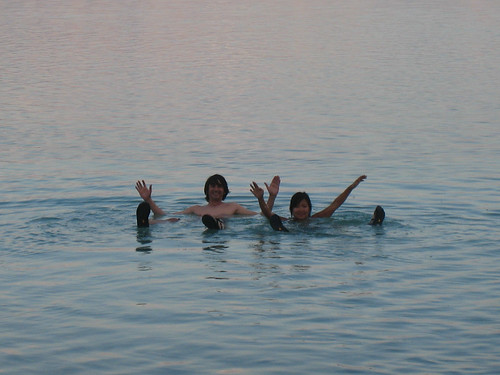
The Dead Sea is 1378 ft below sea level, the lowest point on earth, 35% salinity, 42 miles long, and 11 miles at its widest point. The bottom is lined with a layer of salt crystals, and aside from a few bacteria and microbial fungi, nothing else lives in the Dead Sea.

Contrary to the belief that it is impossible to drown in the Dead Sea, several people each year do . Floating on your back, it’s nearly impossible to drown, let alone get your head underwater because you “bob” right back up. But floating on your stomach is a different matter. What happens is your feet lift up behind you, and your head gets submerged, followed by panic and drowning. Even trying to turn from your stomach to your back can be difficult; you need to build up momentum and flop yourself over onto your back.

Because of the salt content, the water feels thick and slimy. Getting water in your mouth or in your eyes is a bad, bad idea. Accidentally, both happened to me, and I found myself spitting out the water, as it tasted bitter and “poisonous”, and I found myself crying from the sting when water got into my eyes.

hiking in Ein Gedi

Thursday, December 20th, 2007

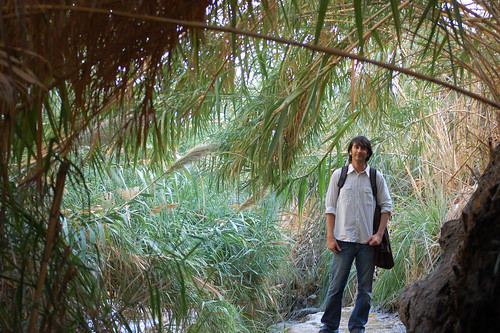
Mike in the Ein Gedi
The area around the Dead Sea is mostly barren, dry desert with mountainous terrain, but there are exceptions…here’s Mike on a hike up to Wadi David waterfall at Ein Gedi National Park, which is a natural oasis situated by the Dead Sea.

can you imagine if this happened in the US?

Monday, December 17th, 2007

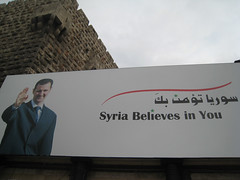
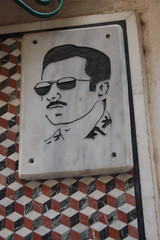
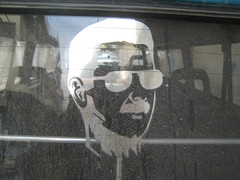
national pride in Syria-2carved on marblenational pride in Syrianational pride in Syria

Do you know who this guy is? We didn’t, either. But from the moment we crossed the border into Syria, we got a crash course. It is not possible to walk more than 20 feet without seeing a poster, picture, billboard, marble portrait, or car decal of President Bashar al-Assad of Syria.

FYI. The same type of “marketing” was true for King Abdullah II bin Al Hussein while we were in Jordan.

Magic Bus

Sunday, December 16th, 2007

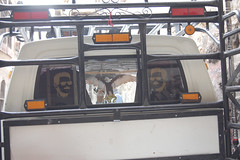
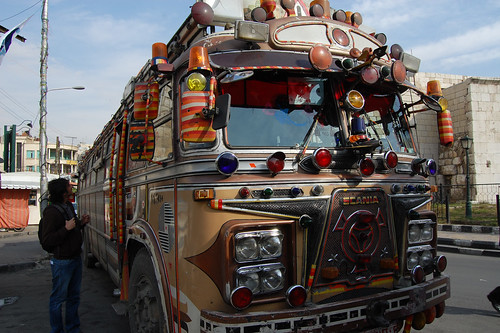
crazy magic mystery city bus of Damascus-2

No one could tell us why, but the public buses in Damascus all look like this. They are made by Scania and I haven’t been able to find any info on the internet either. We saw a bunch of them parked at the gate to the old city and thought there must be a convention in town or something. It probably helped that I am currently reading a book called “Magic Bus” about the old hippie trail from Istanbul to India. Anyway, we both hopped on board and started taking pictures, asking the driver where he was going and how he had managed to score such a crazy looking ride, and in perfect condition too!. He must have thought we were absolutely nuts, because not only did he not understand English, but this was basically the #8 uptown bus and he was just waiting to start his route when a couple of camera wielding tourists hop on and start asking if he’s on his way to Kathmandu. He was friendly though, and even showed us how all the lights on the front still work!

Omayad Mosque

Sunday, December 16th, 2007

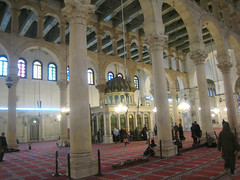
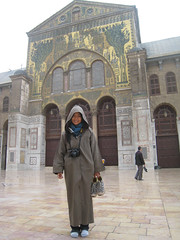
tomb of John the Baptist in the Umayad Mosquewearing special clothes in the mosqueIn the heart of the old city in Damascus is the Omayad Mosque, built in 705ad. The mosque is visited by Muslims and Christians who come to visit the tomb of John the Baptist. Before I could enter the mosque to check it out, I had to put on “special clothes.” The mosque was quite large, and had beautiful gold mosaics depicting paradise.

Run for the border

Saturday, December 15th, 2007

At the last minute we decided to visit Syria. We didn’t know that much about it, except that it’s part of the junior varsity axis of evil, and Damascus is the oldest city on earth. Every travel blog and forum we read told us to ignore whatever preconceptions we had and go because the people are extremely friendly and there is lots of cool stuff to see. The only hurdle was that we didn’t have a visa. We also read that this wouldn’t be a problem if we were willing to wait 5 or 6 hours for them to fax a visa request to Damascus. In fact, it would be only $16 for the visa at the border, as opposed to if we had planned in advance and got one in the US for $100. Yeah procrastination!

The border guard was very friendly and told us he didn’t know how long it would take, but we could hang out in the coffee shop. We debated about whether to wait things out there, or get a room at the conveniently located hotel right at the border and retrieve our passports in the morning. The decision was made for us abruptly as we got a taste of Bedouin revenge. It hit me first and I knew I wasn’t going anywhere. Christine got it the next morning, and both of us were in pretty bad shape the rest of the day. I don’t think there’s a need to go on here, but feel free to email for more details if you are interested.

Wadi Rum

Friday, December 14th, 2007

[kml_flashembed movie=”/wp-content/uploads/2007/12/wadi.swf” height=”400″ width=”570″ /]

After Petra, we went to Wadi Rum. We had a Bedouin guide, who drove us around the desert all day. Luckily it’s winter so the heat wasn’t bad at all. In fact it was a bit chilly in the shade. We spent the day climbing stuff and enjoying the scenery.

[youtube]http://www.youtube.com/watch?v=nzdiiKXxc-I[/youtube]

At the end of the day he took us to our campsite where we would stay for the evening. We were the only ones there, so it was pretty quiet.

[youtube]http://www.youtube.com/watch?v=DC01gS1VOqQ[/youtube]

The number of stars you can see at night in the desert is incredible. We spent the evening eating dinner by the campfire and listening (and sometimes participating) in some Bedouin music.

[youtube]http://www.youtube.com/watch?v=gUf_NX08ha0[/youtube]

Abed and his oud

Thursday, December 13th, 2007

[youtube]http://www.youtube.com/watch?v=V9Xx70G8_88[/youtube]

Goat see

Thursday, December 13th, 2007

[youtube]http://www.youtube.com/watch?v=sQJMZgeXRrY[/youtube]

This was one of those magical travel moments. We were basically alone at the monastery on top of Petra. A young Bedouin girl had just gone and sat inside the monastery and started whistling. The echo reverberated all over the cliffs and all of a sudden there were goats everywhere responding to her call. It was time for them to come home. We stumbled upon this little baby goat which was so playful and followed us around. Then out of nowhere comes this guy (who we would later meet down the hill) singing and playing oud.

Petra

Thursday, December 13th, 2007

We crossed the border from Egypt into Jordan by ferry to get to Petra, one of the new seven wonders of the world. It took us all day to get here. We took a taxi from Mt. Sinai to Nuweiba, then boarded a ferry(which left 3 hours later than scheduled) to Aqaba and finally, took a shared taxi to Petra.

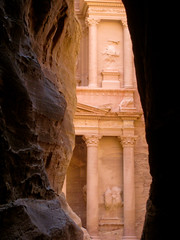
narrow split in rocks opens up to The Treasury We started out the next morning, through the siq, which is the only entrance/exit into Petra. The siq is a long and narrow gorge that opens up into a valley. Because the siq is 240 feet high and more than half a mile long, the Nabataeans who lived here more than 2200 years ago could easily defend their land against attacks, and could monitor those who entered Petra for trade.

The Nabataeans built dams to keep the valley from flooding. They carved temples, tombs and monasteries into the sandstone rocks. And the Romans who came after them built theatres and columned streets. In modern times, the Bedouin lived in the caves that were left behind by previous occupants. It wasn’t until the mid 1980’s that the Bedouin were relocated to a nearby housing project. And although it became forbidden to live in Petra, the Bedouin still work in Petra offering horse, mule and camel rides. They own shops selling souvenirs and jewelry, and have cafes and restaurants.

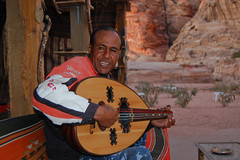
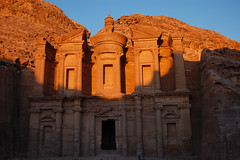
Abed playing his oud, singing songs of lost loveTowards the end of the day, Mike and I climbed up to see the Monastery and to check out the spectacular views from above. We were invited to watch the sunset on the Monastery with Abed who’s family owns the shop opposite the Monastery. He played the oud and sang traditional Bedouin songs while we sipped sweet mint tea. Watching the color of the sandstone change on the Monastery as the sun went down was beautiful and serene.

sunset setting on the Monastery

Once the sunset, Abed suggested we head down the before there was no light to lead our way. Although the hike up to the Monastery was not difficult, it did take about 30 minutes, so I wasn’t thrilled at the prospect of heading down in the dark. Fortunately, Abed’s cousin was heading down at the same time, so he led the way, otherwise I’m quite certain we may have gotten lost on the way down.

Aside from the lights casting out from a few shops along the way, it was pure darkness with only the stars shining so bright above us. We didn’t have a flashlight, instead we used the light from our mobile phones to lead the way back to the entrance of the siq, which took about 45 minutes. It was fantastic to walk through Petra at night, as we had the whole place to ourselves.