Archive for October, 2007

travertine pools of Pammukale

Monday, October 29th, 2007

IMG_4600

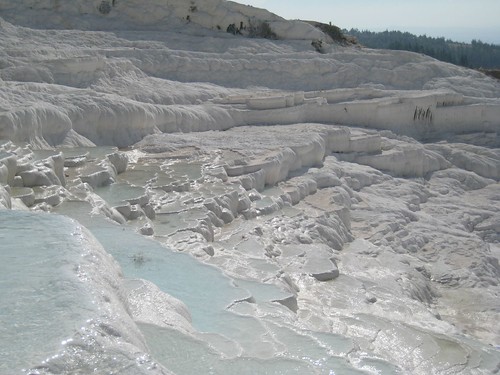
There are two entrances to Pammukale, one is a two kilometer walk to the site, and the other one is only 250 meters. We decided to take the shorter south entrance, which somehow is less frequently used.  Right when you enter, there are man-made pools of water, but as you continue upwards there are more and more natural travertines; some filled with water and some are completely empty.  The stalactites and travertine pools are made from calcium carbonate deposits that come from the hot spring water as it cools.

The entire time we were climbing up, I kept saying to Mike, I don’t get it, how can they let people just walk all over these, don’t they know it will destroy the natural formation of the calcium deposits??

As far back as the Roman times, Pammukale, with its natural hot springs was considered therapeutic and was believed to have restorative powers.  By the 1980’s the hot springs started to dry up due to the hotels using the springs to fill their swimming pools.  In an effort to preserve the site, the hotels have been demolished, and a walkway has been created for the tourists.  Even now, the water flow is still minimal by comparison to what it originally was.

So it turns out we were supposed to walk along a path, which we didn’t see, and there was no one there to tell us.  And while we were enjoying ourselves taking pictures, wondering why more measures weren’t taken to preserve this beautiful site, we were trampling all over it.  I feel awful about this, especially because it’s one of my favorite things I’ve seen.  It was so pretty.  The ridge-like texture of the calcium deposits are so organic and tactile.  And nothing compares to the pale blue water reflecting off the white calcium deposits.

Yes it’s true. Christine can swim!

Thursday, October 25th, 2007

[youtube]http://www.youtube.com/watch?v=bhV-diKpjb0[/youtube]

Today I made a few realizations…

Thursday, October 25th, 2007

IMG_42331. I no longer need the edge of the pool to grasp onto when swimming. I can swim even when I can’t touch the ground (yes, I know. Technically if you touch, you aren’t swimming). Today, despite the clouds marching across the blue sky and chilling the morning air we went swimming on Kalemi Beach in Santorini. The one thing to note about the Mediterranean is that everything floats due to the high salt content. Mike floats without even moving his arms or legs. So that leaves me wondering…what happens when I swim in fresh water??
.

IMG_40722. Mike recently read an alarming fact– the average Greek eats 24 liters of olive oil per year. Can you imagine?? Italy and Spain rank up there too with 12L and 13L, respectively. So how does that factor into my realization for today? For starters, we’ve been away for 3 months spending most of our time in Spain, Italy and Greece. Secondly, I think I always knew this, but…I realize, I love olive oil. Lastly, it’s a good thing we weren’t in Greece for the whole time, as I could have been ingested up to 6 litres of olive oil–like drinking a 2Liter of Diet Coke each month of OIL! Unfathomable. Thankfully, tomorrow we are headed to Turkey. Apparently the average Turk only eats about 1.2L of olive oil per year. (photo: no amount of olive oil would help these suckers go down.)

IMG_43703. Lastly, I haven’t posted our itinerary in a while, so it’s time I do.
Oct. 26-Nov. 9: Turkey, traveling to Selcuk, Antalya, Cyprus, Cappadocia,
Nov. 10-Nov. 24: Egypt, traveling to Cairo, Aswan, Luxor, Dahab
Nov. 24-Nov. 28: Jordan, traveling to Petra
Nov. 28-Dec. 4: Oman and UAE
Dec. 4-Jan 31??: Kenya, Tanzania, Malawi, Mozambique, Zimbabwe, Swaziland, South Africa.

our visit with Carolyn

Saturday, October 20th, 2007

IMG_3978

Carolyn extended a work trip and made a detour from Frankfurt to Greece.  Since our time together was limited, we picked Poros based on its proximity to Athens.  We wanted to be sure we did not spend our time in transit.  We rented a great little apartment in the heart of Poros town.       
.

.

.

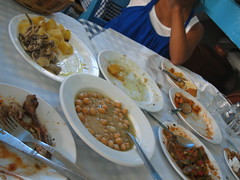
IMG_9890We spent our time doing what we know best… eating, drinking and lazing around.  Our movements the last four days centered around talking about our last meal, wondering about our next meal, and deciding if we should open another bottle of wine. 

*This was one of our best meals.  Roasted pork, roasted chicken, green beans in tomato sauce, fava beans in dill and tomato sauce, roasted potatoes in lemon, and chickpeas (which we clearly didn’t like).  We couldn’t wait to eat, so there is no pre-meal photo. 
.
.

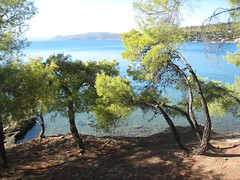
IMG_4042We got lucky with the weather.  In the mornings and evenings its cool, but during the day its warm enough to swim in the clear waters of the Mediterranean.  After a night of over-indulging, Carolyn and I woke up early one morning to go for a morning swim.  We alternated between running and walking to one of the far beaches so we would be warm enough to jump in.  The Greeks must think we are crazy.  Most of them are wearing jackets and bundling up while we are laying out on the beach.


.

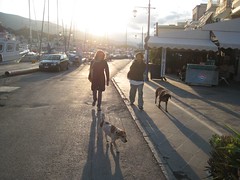
IMG_3910We also made some friends…

*There is one last thing that we spent hours debating during Carolyn’s visit.  Apparently the Greek plumming system is quite delicate.  The travel books (and our apartment) advise against putting any paper products in the toilet.  Stating, the plumming can be damaged by flushing “anything larger than a stamp.”  We decided, we’re Americans, but in partial respect to the Greeks, only used two squares a flush…

Monasteries in Meteora, Greece

Tuesday, October 16th, 2007

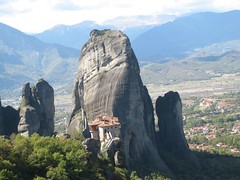
monastery perched on mountaintop

Before we headed to Poros to meet Carolyn, we stopped off at Meteora.  Built in the 14th century, there were 24 different monasteries perched upon the mountaintops.  The photos really do not capture the beauty and make tangible the incredible genius to be able to build on such difficult terrain.  Only 6 of the 24 monasteries remain, the rest have been left in ruins.  

Perfect day to relax

Tuesday, October 16th, 2007

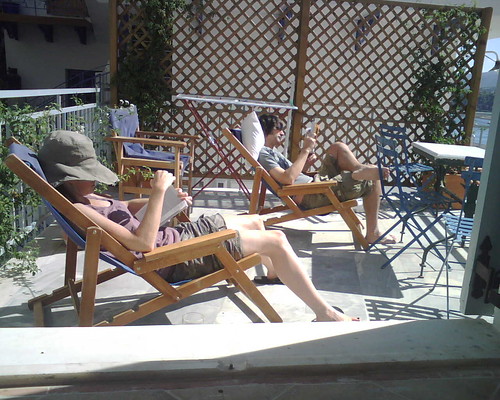
Hanging out on our balcony overlooking the water with Carolyn in Poros.

Albanians are crazy fun

Saturday, October 13th, 2007
Albanians are crazy   Albanians are fun
     
Before the fall of Communism in the 90s, there were less than 2000 cars in the country. The only people allowed to drive them were government officials. Car ownership required a permit from the government, which in 45 years only 2 were issued to nonparty members. The result is that almost everyone in the country has been driving for less than 10 years.   Now that everyone is behind the wheel (of a Mercedes none the less) the entire country is like a hopped up teenager who just got their license. Combine that with the fact that because there were so few cars around before, there was never a need to invest in roads, and you are left with a fast and furious joy ride that leaves even those with the strongest of stomaches ready to lose their lunch.
     
Many Albanians follow something called “The Kanun”, one part of which is a code of honor which states that if a member of the family is murdered, it is the duty of the male members to avenge his death, resulting in an endless cycle of killing.   The other part of the Kanun is the code of hospitality in which the guest takes on a godlike status. There are 38 articles giving instructions on how to treat a guest. An abundance of food drink and comfort…and even better… the duty of the host to avenge the murder of his guest should it happen during their visit.
     
95% of the country is of Albanian decent. One of the most homogeneous countries in the world.   This makes people extremely curious about foreignors. If they speak English they will be very inquisitive. If they don’t they will stare at you like you just stepped off of a spaceship.
     
Indestructible bunkers in case of war. built between 1950-1984.Having blown off Russia, Yugoslavia and China, Albania had no allies, so it hunkered down and prepared for the worst. They built 700,000 of these little bomb shelters. The country is littered with them. To test them out, the chief engineer was made to stand inside of one while it was bombarded with tank artillery fire.   It makes for a fun way to pass the time driving trying to spot the bunkers. Apparently the Albanians have found more interesting ways to use these structures over the years, as many people have stories of losing their virginity in one.
     
In the late 90s almost the entire country lost their life savings in a government sponsored pyramid scheme. 70% of the population lost an estimated 1 billion dollars.   Pyramid scheme. Are you serious??? Someone should warn these guys about Nigerian political exiles sending spam emails.
     
Albanians use a currency called Leks. There are old Leks and new Leks. If something costs 1000 Leks, for some reason people will say 10,000 Leks, meaning 10,000 old Leks even though the old Lek was abolished decades ago. People think in old Leks even though you use new Leks.   Luckily people are very honest, so when you give someone 10x the price, they laugh and magically erase a zero from the bill. It’s like getting a 90% discount on everything you buy.
     
Albanians are extremely hospitable to foreigners. They will ask you to coffee and more than likely this will mean more than coffee. It is highly offensive to reject this offer and even more offensive to to pay for the drinks. Albanians will go to great lengths to prevent you from paying.   What could be more fun than this?

travel tales…

Thursday, October 11th, 2007
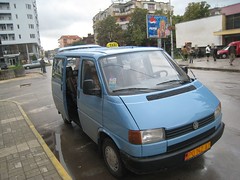
Furgens or minibus depart when the vehicle is fullWe spent the last week traveling by bus, furgen(VW mini bus with no set schedule), taxi, train and by foot.  We’ve walked across the border in two countries, rode overnight in smoke filled buses, broke down in a bus.  We’ve both experienced motion sickness from driving up and down the mountainous terrain.  In Albania, we were pushed from one means of transport to another without fully understanding what was happening and some how got to where we wanted to go.  We’ve spent more than 45 hours in travel time this last week, which doesn’t include waiting in bus terminals or for our next transfer.  We’ve seen quite a bit of the Balkan peninsula, and the people we have encountered have all been genuinely friendly, going so far as, providing snacks on our journeys.  In Albania, a stranger eating in the same cafe as us drove us back to our hotel free of charge because it was raining and there were no taxis. 
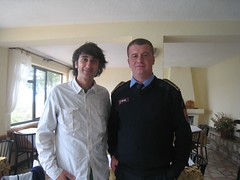
Mike with our Albanian immigration officerProbably the most memorable encounter was with an Albanian immigration officer.   We walked across the Albanian border and after our passports were stamped in, one of the border guards asked if we would like to join him for coffee.  In the cafe he ordered coffee and a shot of reki for each of us.  Reki, typically made from grapes or mulberrys, is a clear liquor similar to vodka.  It was 10am and we were already drinking shots.  Rinaldo was very friendly and genuinely curious about life outside Albania.  He studied in Turkey, speaks 4 languages, and has applied to continue his studies in the US.  
An hour and four shots later, we were on our way, and Rinaldo was back to work controlling the border.  Turns out only 100 people enter/exit per day from Sveti-Naum, Macedonia thru Tushimisht, which is where we entered Albania.  Although highly unusal, it was a nice welcome into Albania. 
 

Sarajevo, Bosnia & Herzegovina

Wednesday, October 10th, 2007

Do you remember what you were doing in 1992? I do. Chances are I was folding Free People boatneck tees or Girbaud jeans on State Street in Ann Arbor. Or I might have been splitting half a large pizza with Danielle at 2am after a night out at Sigma Pi. Or maybe I was in class or just maybe I was studying. For me, life was fun and I had a worry-free young adulthood. But that wasn’t true for the rest of the world. In Bosnia & Herzegovina (BiH), the people were being traumatized by non-stop shelling. They were losing their family and friends to sniper shots. And they were attending funerals in the dark because it was too risky during the day.

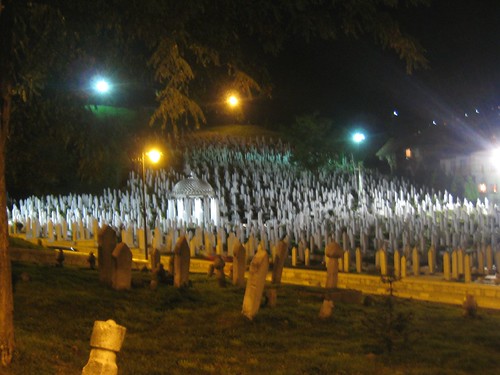
cemetary

Historically, Sarajevo was an important city based on it’s strategic location between the far east and Europe. There are many Turkish influences in Sarajevo as a result of 400 years of Ottoman rule–the food, the city bazaar and Islamic mosques. And after the Turks, the Austro-Hungarians ruled for 40 years before WWI leaving behind Christianity and Judaism along with religious and cultural tolerance. In 1992 Yugoslavia was formally disolved into Croatia, Serbia, Slovenia, Republic of Macedonia, Montenegro, and Bosnia & Hercogovina. However Serbia felt Bosnia & Herzegovina was rightfully their land and set out to claim it, thus the Bosnian War. Of course, there are two sides to every story, but the one I heard is tragic anyway you look at it. For 4 years between 1992-1995, Sarajevo was under siege by Serbia. During this time, Serbia attempted genocide on all non-Serbs killing 11000 people. NATO forces finally intervened and eventually pushed the Serbs out of BiH.

How could this happen to Sarajevo, a city who’s future looked so bright. In 1984 Sarajevo had the honor to host the winter Olympics, and 8 years later there was a war. There is still evidence of the destruction; burned out apartment buildings still stand, and bullet holes can be seen in many buildings. Although much of the city has been rebuilt, there are many houses that still lay dilapilated and untouched since the war. Apparently there is the question of ownership with these homes, as the city can not verify who the rightful owner is, and more importantly, if the owner is still alive after the war. So instead, these homes lay in ruins, a constant reminder of what the war did to the city and people of Sarajevo. But Bosniaks are survivors. We had an amazing tour guide, Fikret Kahrovic who lived to tell his story of Sarajevo. Fikret moves forward with unbelievable optimism. And although he claims, Bosniaks love to complain, he personally, feels he has no right to complain because it would be selfish since there is always someone who fared far worse than he did [after the war].

An evening with a few strangers who may or may not be related to me

Tuesday, October 9th, 2007

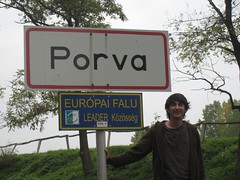
Porva Hungary A few years ago, I was at Brigid’s in the Art Museum area when I noticed that half of my beers had been comped by the bartender. I didn’t question or think too much about it until the next time I went back and was greeted with, “Hey, you’re not Carl’s brother!” Apparently I looked a lot like this guy Carl who was a regular at the bar, so the staff had sent over a few free brews figuring I must be his brother. Years have gone by since, but still whenever I go to Brigid’s, the bartender greats me with a wink as Carl’s brother. These are my personal “Norm entering Cheers”-esque moments where sometimes I want to go where everybody knows my (albeit fake) name.

Fast forward to the present. Christine and I walk into a bar in this little town in Hungary called Porva fully expecting everybody to know our (Gartner) name. After all, there’s only something like 600 residents in this town and over the years a few dozen of them were named Gartner. A friend of my grandmother’s had once told me that my Dad’s family immigrated to the US from Porva in the early 1900s and that all of the men in the town looked just like me. (I know, I know. Hard to imagine such a good looking town) I had also tracked down information that there were still some Gartners living there, but whether they were related to me or not was a mystery since Gartner is a pretty common name in the area.

No need to worry about all that. We had a plan. We would walk in to the town bar, the music would stop and we’d all do a double take as everyone would think they were looking into a mirror (everyone except Christine that is). There would be no need to explain. This time I wasn’t going to be Carl’s fake brother, this time I was going to be Carl and eveyone would know my (real) name.

…What really happened.

Helpful local in Porva Ok so this guy looks nothing like me… and he was the best looking guy in the bar! I guess things have changed a bit in the last 100 years. Or maybe they haven’t changed at all and that mean little old lady was trying to tell me something. Regardless, it soon became obvious that our task at hand was going to be a bit more difficult. Our new friend didn’t speak English. In fact nbody spoke English. We had drawn a family tree anticipating this and after a little pointing at the chart and then at me, he seemed to understand and acknowledged that he knew the Gartners. He bought us a shot and gave us directions.

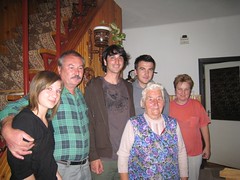
Long lost relatives?When we got to the house the Gartners were outside. Now imagine what you would do if a complete stranger showed up at your doorstep and you couldn’t understand a word they said except for them repeating your last name and pointing back and forth at you and them. Well you’d invite them in for dinner wouldn’t you! Luckily we had our trusty family tree and a few pictures and even more lucky, they had a 17 year old daughter who spoke some English. Before we knew it they had gone and got the grandmother from next door, pulled out a bunch of lists of their own geneological research and started comparing notes with me. Although not on their list, the grandmother confirmed my version of the family tree and the fact that her husband’s father had a brother named Joseph who left for the US. That Joseph was my grandfather. So for those of you keeping score at home these are my 3rd and 4th cousins! It was actually kind of exciting and I know they were glad to see us because they wouldn’t let us leave! They said it was like a dream that we were there. Considering they were also researching the family name I can see that it was kind of like Google showing up on your front door and hitting the “I feel lucky” button. Now none of this can really be proven. All of the confirmation came from an 88 year old woman who didn’t speak English, translating through 17 year old girl who spoke just a little English. Either way, we had a nice evening with a nice Hungarian family.

food and drink encounters…

Sunday, October 7th, 2007

I figured since there aren’t many photos of Vienna or Budapest, maybe I could just write a few things about the food we’ve had in the last week…
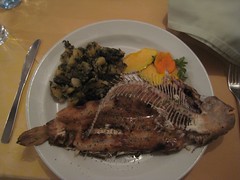
IMG_3339Fried sole with potatoes and chard from Lake Bled, Slovenia.  The presentation is remarkable.  I’ve only seen this done once before.  In Japan, the bones of the fish are served standing up with a long toothpick along side its sashimi.  The presentation is odd, but even more so when you realize the body continues to “beat” so you know it’s very fresh. 

The sole in this case was well cooked, and tasty.  The potatoes and chard were a bit beat up and dry, though.

.
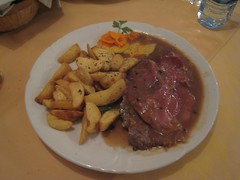
IMG_3340Portion sizes in Slovenia are pretty big, along with the layering of different meat and some sort of gravy.  This is beef with a layer of ham, and a bunch of gravy, served with fries.   This was Mike’s meal, and he said it was good.  I have my doubts, though.

.
.
.

.
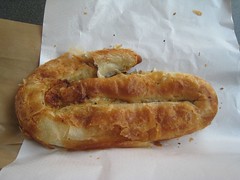
IMG_3342This delicious flaky pastry is called burek.  It doesn’t look too appetizing, but believe me, it is good!  It’s made with phyllo dough, and can be filled with ground beef, spinach, cheese, apple, etc.  It’s greasy and savory (or sweet)– my kind of treat.

It is said to be a Slovenian specialty, but we found it again in Austria.  But Google says it’s Turkish.

.

.
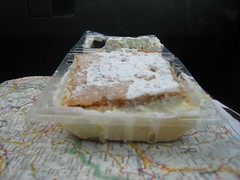
IMG_3346This is kremma snezna rezina or cream cake.  Sorry for the photo, we weren’t hungry at the time, so we took it to go.  It is made of phyllo dough on the top and bottom with layers of vanilla custard and fresh whipped cream.  This is a Bled, Slovenia specialty, and, oh, is it special!  so delicious.

.

.

.
IMG_3362

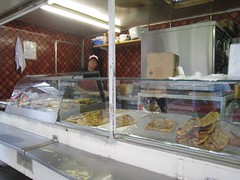
This food vendor sells pita, burek, and my new favorite, gozleme.  The only difference with the burek and gozleme is the dough.  The gozleme can be stuffed with the same kind of fillings as the burek, but the dough is more like roti or a heavy crepe, not made from phyllo dough. 

I got the spicy meat gozleme, and it was yummy.

.
.
.
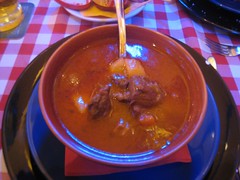
IMG_3370 I always thought goulash was noodle soup with beef.  Apparently in Hungary, it’s a little different.  Or maybe it was the fact we were at a restaurant called “El Greco” in Budapest.  This was a beef broth soup with chunks of beef, potatoes, carrots, and paprika.  They also served hot sauce on the side, kind of like the Vietnamese sriracha sauce.  Turns out this was one of the best soups I’ve had, and the Greek food we were served was really bad.

.

.
 IMG_3458
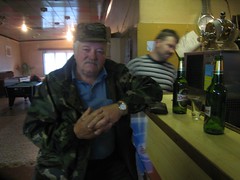
In search of Mike’s relatives in Porva, Hungary we decided the best place to start looking was to go to where people might gather– the local bar.  We figured we could speak with people, see if they know the Gartners, and get know Porva.  Finding the bar was easy, as there is only one main road, and one bar, and one restaurant, and one grocery store…

This nice barfly(with very few teeth) invited us to sit down next to him.  We discussed the Gartners’ or rather pointed to the piece of paper with the family tree drawn out, and he said he knew them.  Of course he did, the town only has 600 residents!  He spoke to us in German and Hungarian, we gestured back nodding in agreement of whatever he was saying.  Then he bought us a shot of Betyar Vegyes.  I’m not sure what it was but it tasted like vodka flavored with cassis.  Then of course, not to be rude we had to buy him one before departing.  It is said that Hungarians like to do shots for just about any reason, and this guy was no exception to the rule. 
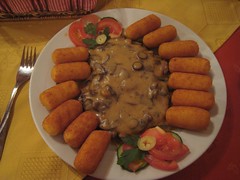
IMG_3470This was Mike’s last dinner in Hungary.  Again–what is it with the layering of meat?  It was beef with another layer of meat with mushroom gravy and 13 tater tots.  Not my kind of thing, but Mike liked it okay.

The food (and drink) overall has been pretty good with a few exceptions here and there.  
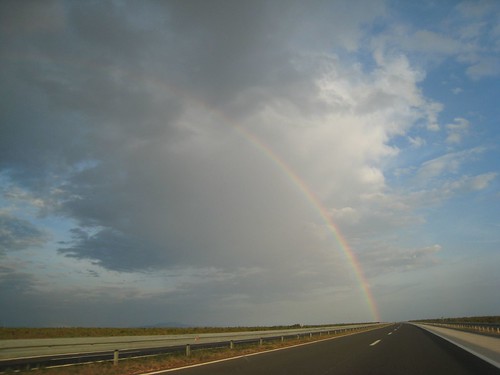
pot of gold

Sunday, October 7th, 2007

IMG_3485

The last week has been a bit of a blur trying to go everywhere and visit every city between Croatia, Slovenia, Austria, and Hungary. After only two days in Slovenia we drove up to see Leo in Vienna for two days, then to Budapest for one day, then down to Porva for one night. The end result is that we probably missed out on really getting to know any one city very well.

If we could do it again, I would spend a week in Slovenia and at least 3 or 4 days in Vienna and Budapest, but even as I write this, we are on a tight schedule, again. We are meeting Carolyn in Greece on the 14th, which gives us a week to get there, but we’re traveling by bus(roughly 42 hours this week on the bus) through the Balkans. Sarajevo, Skopje, Ohrid, Tirana, and Gjirokastra are on the list of cities to visit on the way down to Athens.

Last night we drove back to Croatia, to catch a bus this morning. Here’s one last look at beautiful Croatia.

A visit with Leo in Vienna

Saturday, October 6th, 2007

IMG_8922We took a detour from our original plan, and decided to visit Leo and Petra in Vienna. Unfortunately, a business trip took Petra out of town the day after we arrived, and since Leo only arrived in Vienna a few days before us, he took us to the only area he knew…the Naschtmarkt–the farmers market/outdoor restaurant area. We spent the entire day in the same area, wandering around– eating and drinking beer and sturm–my favorite things to do.

Sturm, a seasonal drink produced by Austrians, is made of just-pressed grapes and looks a bit cloudy. It can be white or red, just like regular wine, but the alcohol content is much higher. (sorry, there is no photo.)

Although it was a short visit with Leo, it’s not the last we’ll see of him. We’re already making plans to meet in Egypt to go scuba diving sometime in November.

Lake Bled, Bohinj and the Alps

Monday, October 1st, 2007

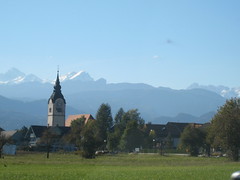
drive to Lake Bled, with backdrop of Julian AlpsYesterday we drove to Lake Bled, an hours’ drive from metropolitan Ljubljana, which is like being transported in time. The lush green valleys look peaceful and right out of a storybook, and the Julian Alps in the backdrop are so breathtaking.  We took an afternoon bike ride around the lake, and enjoyed a pleasant sunset over Lake Bled.

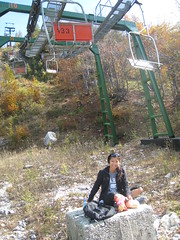
picnic lunch under the ski liftWe went to Bohinj today.  We took a gondola ride up the mountain and hiked around. We stopped for a picnic lunch under a ski chairlift. Looking out at the snow tipped Alps made me want to go skiing, instead I got a bee sting.